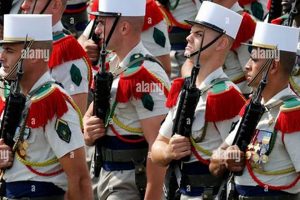
The annual event held in France on July 14th features a procession of armed forces personnel, military vehicles, and aircraft. It is a prominent display of national defense capabilities and military traditions. The ceremony typically occurs along the Champs-lyses in Paris, with the President of France presiding over the spectacle.
This tradition serves as a significant marker of French national identity and commemorates the storming of the Bastille prison in 1789, a pivotal moment in the French Revolution. Beyond its historical symbolism, it showcases the country’s commitment to security and its alliances with other nations, often including participation from foreign military contingents. The event fosters national pride and public awareness of the armed forces.
The following sections will delve into the specifics of its historical underpinnings, the logistics involved in its execution, and its cultural significance both domestically and internationally. Further discussion will address the economic impact, security measures, and evolving nature of this annual observance.
Guidance on Attending the Event
Careful consideration and planning are essential for optimal experience during this significant national observance. Awareness of logistical details, security protocols, and cultural sensitivities contributes substantially to a respectful and informed engagement.
Tip 1: Plan Accommodation and Travel Well in Advance: Securing lodging and transportation arrangements requires early action. Given the high volume of visitors, hotels and train tickets experience considerable demand. Booking months in advance is highly recommended to ensure availability and favorable pricing.
Tip 2: Arrive Early to Secure a Viewing Spot: Prime viewing locations along the Champs-lyses become occupied early in the morning. Arriving several hours before the scheduled start time is crucial for obtaining an unobstructed view of the procession.
Tip 3: Be Aware of Security Procedures: Expect stringent security measures, including bag checks and potential screenings. Familiarize yourself with prohibited items and adhere strictly to instructions provided by security personnel to facilitate a smooth entry.
Tip 4: Dress Appropriately and Comfortably: Comfortable attire and footwear are advisable, considering the extended period of standing and potential for varying weather conditions. Sunscreen, a hat, and water are also recommended, particularly during warmer months.
Tip 5: Respect the Solemnity of the Occasion: Demonstrating respect for the events significance is paramount. Refrain from disruptive behavior and maintain a reverent demeanor during the parade and related ceremonies.
Tip 6: Utilize Public Transportation: Navigating Paris by public transportation is generally more efficient than driving, particularly on the day of the event. The metro and bus systems offer extensive coverage and are frequently used by attendees.
Tip 7: Stay Informed of Schedule Changes: Official sources should be consulted for potential schedule adjustments or unforeseen alterations to the program. Real-time updates are typically available through government websites and news outlets.
Effective preparation ensures a more rewarding and enriching experience. By prioritizing logistics, security, and respectful conduct, attendees can fully appreciate the historical and cultural importance of this national tradition.
The subsequent sections will elaborate on the historical origins of the celebration and delve into the specific components that constitute the modern event.
1. National holiday

The designation as a “National holiday” is intrinsically linked to the prominence of the annual armed forces event. The former elevates the latter from a mere military exercise to a nationwide celebration imbued with profound historical and patriotic symbolism. As a nationally recognized day of observance, the event garners widespread public attention and participation, solidifying its role in shaping collective national identity. The “National holiday” status provides the framework within which the procession is understood and experienced by citizens.
The causal relationship is evident: the day commemorates the storming of the Bastille, a pivotal event in the French Revolution. To honor this foundational moment, the nation suspends normal activities, fostering an environment conducive to collective remembrance and patriotic expression. For instance, businesses and schools close, enabling greater public engagement with the commemorative events, including the parade. This widespread participation amplifies the parade’s impact, transforming it into a powerful demonstration of national unity and resolve.
In essence, the “National holiday” designation acts as a catalyst, transforming what would otherwise be a conventional military display into a deeply meaningful cultural phenomenon. By acknowledging the historical importance of the event and fostering widespread participation, the “National holiday” status amplifies the procession’s power as a symbol of national identity and unity. The understanding of this link underscores the importance of national holidays in shaping a country’s collective memory and reaffirming its foundational values.
2. Military display
The component of a “Military display” is central to the identity of the annual Bastille Day event. It serves not merely as a demonstration of martial prowess but also as a symbolic representation of national strength, technological advancement, and historical continuity. It constitutes a primary draw for both domestic and international audiences.
- Equipment Showcase
The event provides a platform to display the armed forces’ hardware, ranging from advanced fighter jets and armored vehicles to specialized equipment used in modern warfare. For example, the parade might feature Rafale fighter jets, Leclerc tanks, or newly developed reconnaissance drones. This element demonstrates technological capabilities and serves as a deterrent to potential adversaries.
- Personnel March
The marching of various military units, including infantry, naval detachments, and specialized corps, symbolizes discipline, order, and the collective commitment of the armed forces. The precision of the march, the uniformity of the dress, and the coordination of movements exemplify the training and readiness of the military personnel. The inclusion of diverse units highlights the breadth of military expertise within the armed forces.
- Flyover Formations
Aircraft flyovers are an integral part of the procession, demonstrating air power and technological sophistication. These formations often involve intricate aerial maneuvers and coordinated displays, capturing public attention and symbolizing national air defense capabilities. For instance, the Patrouille de France, the French Air Force’s aerobatic demonstration team, performs during the event, showcasing precision flying skills.
- Historical Representation
The inclusion of historical military units, vintage vehicles, and period-accurate costumes connects the modern armed forces to its historical roots. This aspect reinforces the sense of continuity and tradition, emphasizing the historical lineage of the military and the sacrifices made by past generations. It serves as a reminder of the military’s role in shaping national identity and safeguarding sovereignty.
The elements of equipment showcase, personnel march, flyover formations, and historical representation, collectively define the “Military display” aspect of the annual observance. The display is not just a show of force but also an affirmation of national identity, a commemoration of history, and a projection of technological advancement. These factors contribute to the event’s importance both domestically and internationally, solidifying its role as a symbol of national pride and a demonstration of military capabilities.
3. French Revolution

The French Revolution provides the foundational context and enduring significance for the annual armed forces event. The historical events of 1789, particularly the storming of the Bastille, directly inform the symbolic meaning and national importance attributed to the modern-day observance.
- Storming of the Bastille
The assault on the Bastille prison on July 14, 1789, represents a pivotal moment of defiance against royal authority and symbolizes the overthrow of oppression. The event’s inclusion within the parade narrative serves as a reminder of the revolutionary ideals of liberty, equality, and fraternity. The imagery and historical context of the Bastille are woven into the ceremony, linking modern military capabilities to the nation’s revolutionary origins.
- The Declaration of the Rights of Man and of the Citizen
This foundational document, adopted in the wake of the revolution, established principles of individual rights and freedoms that continue to shape French society and governance. The annual event indirectly celebrates these principles, showcasing the nation’s commitment to the values enshrined in the Declaration. The military display can be viewed as a demonstration of the state’s capacity to protect these rights and freedoms.
- The End of the Ancien Rgime
The French Revolution marked the definitive end of the Ancien Rgime, the system of aristocratic privilege and absolute monarchy that had characterized France for centuries. The parade serves as a symbolic rejection of the old order, celebrating the establishment of a republic based on the principles of popular sovereignty and civic participation. The presence of military personnel underscores the nation’s commitment to defending the republican ideals born out of the revolution.
- National Identity and Unity
The revolution played a crucial role in forging a unified French national identity. The annual event functions as a powerful symbol of this national unity, bringing together citizens from all walks of life to commemorate a shared history and reaffirm common values. The parade reinforces the sense of collective identity and patriotism, solidifying the nation’s commitment to its revolutionary heritage.
These facets highlight the inseparable link between the French Revolution and the annual armed forces event. The former provides the historical and ideological underpinnings for the latter, transforming it from a mere military display into a potent symbol of national identity, revolutionary ideals, and the enduring commitment to liberty, equality, and fraternity. The event functions as a yearly reminder of the sacrifices made during the revolution and the ongoing responsibility to uphold the principles for which it was fought.
4. Champs-lyses

The Champs-lyses, a renowned avenue in Paris, serves as the primary stage for the annual military procession. Its selection as the venue is not arbitrary; rather, it is intrinsically linked to the avenue’s symbolic significance and its physical characteristics that facilitate the event’s execution. The avenue’s grandeur and historical resonance amplify the spectacle, transforming it from a conventional parade into a nationally significant demonstration of strength and unity. The width and length of the Champs-lyses permit the extensive display of military personnel, vehicles, and aircraft, ensuring maximum visibility for the assembled public and dignitaries.
The avenue’s historical context further reinforces its importance. As a site of numerous national celebrations and significant historical events, the Champs-lyses embodies the spirit of France. Its association with national pride and collective identity makes it an ideal location for commemorating the storming of the Bastille and showcasing the nation’s armed forces. For example, victory parades following major wars and national holidays have historically utilized the Champs-lyses, establishing a precedent for its role as a venue for national expressions. The physical layout of the avenue, with its wide boulevards and clear lines of sight, is critical to the orderly and impactful presentation of military assets.
In summary, the Champs-lyses provides the necessary infrastructure and symbolic weight to elevate the annual military event to a level of national importance. Its physical characteristics, historical associations, and cultural significance converge to create a venue uniquely suited to this large-scale demonstration of national pride and military capability. The understanding of this connection underscores the importance of location in shaping the meaning and impact of national events.
5. Presidential review

The “Presidential review” forms a cornerstone of the Bastille Day military parade, signifying the head of state’s authority as commander-in-chief and underscoring the civilian control over the military. It is a formal inspection and acknowledgment of the armed forces’ readiness and dedication to national defense.
- Symbolic Authority
The presence of the President during the Bastille Day military parade symbolizes the civilian government’s oversight and responsibility for the armed forces. As the head of state, the President’s review serves as a visible affirmation of this power structure, reinforcing the democratic principles of governance. The public acknowledgment by the President of the military’s commitment strengthens the bond between the armed forces and the citizenry.
- Inspection of Military Readiness
The review allows the President to personally witness the readiness and capabilities of the armed forces. The inspection involves observing military units, vehicles, and equipment, providing an opportunity to assess the preparedness and effectiveness of the nation’s defense apparatus. The public display of military assets serves as a message to both domestic and international audiences regarding the nation’s defense capabilities.
- Honoring Military Personnel
The Presidential review provides an opportunity to recognize and honor the service and sacrifice of military personnel. The parade serves as a tribute to the dedication and professionalism of the armed forces, acknowledging their role in safeguarding national security and upholding the nation’s values. Medals and citations may be awarded during the ceremony, recognizing outstanding achievements and acts of valor.
- National Unity and Patriotism
The Presidential review contributes to a sense of national unity and patriotism. The presence of the President, the display of military strength, and the commemoration of historical events foster a collective sense of pride and identity. The parade serves as a rallying point for citizens, reinforcing their commitment to the nation and its values.
These facets of the Presidential review are integral to the Bastille Day military parade, underscoring the civilian authority over the military, the readiness of the armed forces, the honoring of military personnel, and the promotion of national unity. The President’s participation reinforces the event’s significance as a demonstration of national strength and commitment to defending the nation’s interests.
6. Foreign participation

Foreign participation in the Bastille Day military parade serves as a deliberate expression of diplomatic relations and military alliances. The inclusion of foreign military contingents signals solidarity with France and underscores shared values related to security and international cooperation. This presence is not merely symbolic; it demonstrates a commitment to mutual defense and reflects ongoing collaborations in military training, peacekeeping operations, and counter-terrorism efforts. For example, in recent years, troops from Estonia, Spain, and Germany have marched in the parade, representing nations with which France maintains close defense partnerships.
The selection of participating foreign nations often corresponds to specific geopolitical considerations. Invitations may be extended to countries involved in joint military operations with France or to those with which France seeks to strengthen diplomatic ties. Furthermore, the presence of foreign military bands and displays of national uniforms offer a visual representation of cultural exchange and mutual respect. The practical significance of this element lies in its reinforcement of alliances, its promotion of interoperability between armed forces, and its projection of a unified front on matters of global security. Consider, for instance, the inclusion of African nations’ representatives, which highlights France’s historical links and continued engagement in security matters across the continent.
In conclusion, foreign participation in the annual military procession is a strategic component that reinforces international partnerships, demonstrates interoperability, and projects a message of collective security. Challenges may arise in ensuring equitable representation and navigating complex geopolitical dynamics. Nevertheless, the inclusion of foreign contingents remains a crucial aspect of the event, symbolizing shared values and collaborative defense strategies on a global scale.
Frequently Asked Questions
The following questions and answers address common inquiries regarding the annual event, providing clarity on its purpose, logistics, and significance.
Question 1: What is the historical origin of the Bastille Day Military Parade?
The tradition is rooted in the commemoration of the storming of the Bastille prison on July 14, 1789, a pivotal event of the French Revolution. The parade serves as a symbolic reaffirmation of the revolution’s ideals and the establishment of the French Republic.
Question 2: Where does the event take place, and what are the key landmarks along the route?
The main event occurs along the Champs-lyses in Paris. The route typically begins near the Arc de Triomphe and proceeds towards the Place de la Concorde. Notable landmarks along the route include the Grand Palais and the Tuileries Garden.
Question 3: Who typically participates in the Bastille Day Military Parade?
Participants include various branches of the French armed forces (Army, Navy, Air Force, Gendarmerie), as well as foreign military contingents from allied nations. Civilian organizations, such as fire brigades and police units, may also be involved.
Question 4: What types of military equipment are typically displayed during the event?
The display includes a range of military equipment, from infantry and armored vehicles to aircraft flyovers. Modern weaponry, as well as historical vehicles and equipment, may be showcased to demonstrate the evolution of the French armed forces.
Question 5: How is security managed during the Bastille Day Military Parade, and what measures are in place to ensure public safety?
Extensive security measures are implemented, including a heavy police presence, bag checks, and restricted access zones. Airspace restrictions are also enforced. Security protocols are coordinated between military and civilian authorities to mitigate potential threats.
Question 6: Why is foreign participation considered important in the Bastille Day Military Parade?
Foreign participation symbolizes diplomatic alliances and military cooperation between France and other nations. It demonstrates solidarity and mutual commitment to shared security objectives.
The answers provided offer a concise overview of key aspects surrounding the event, fostering a better understanding of its historical context, logistical details, and significance.
The next section will explore the economic impact and cultural influence of the annual armed forces demonstration.
Bastille Day Military Parade
This analysis has explored the multi-faceted significance of the Bastille Day Military Parade. The investigation encompassed its historical underpinnings, its role as a demonstration of national military capabilities, its symbolic representation of revolutionary ideals, the strategic importance of its location, the function of the presidential review, and the diplomatic implications of foreign participation. Each of these elements contributes to a complex and evolving understanding of this annual national event.
The future of the Bastille Day Military Parade will undoubtedly be shaped by evolving geopolitical realities, technological advancements in military hardware, and shifting national priorities. Continued scrutiny of this event remains crucial for understanding not only France’s national identity and military posture, but also its role in international affairs and its commitment to the values enshrined in its revolutionary history. The parade serves as a potent reminder of the past, a stark representation of the present, and a symbolic projection of the nation’s future trajectory.