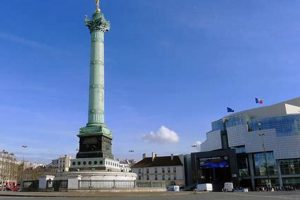
The geographic location referred to is situated in the eastern part of Paris, straddling the boundaries of the 4th, 11th, and 12th arrondissements. It is centered around the Place de la Bastille, a historically significant square. This area encompasses a network of streets and landmarks radiating outwards from this central point.
This locale holds substantial historical and cultural significance for France. It marks the site of the former Bastille prison, a symbol of royal authority stormed during the French Revolution. Today, the area is a vibrant hub of Parisian life, offering a blend of historical sites, modern amenities, and diverse cultural experiences. Its accessibility and central position make it a focal point for both residents and tourists.
The subsequent discussion will elaborate on specific points of interest within the identified vicinity, exploring its transportation infrastructure, notable landmarks, and the overall character that defines this part of the French capital.
Effective navigation of the district requires an understanding of its layout and the available resources.
Tip 1: Utilize Public Transportation: The area is well-served by the Paris Metro. Lines 1, 5, and 8 converge at the Bastille station, providing access to various parts of the city. Understanding the metro map and ticket options is crucial for efficient travel.
Tip 2: Familiarize Yourself with Key Landmarks: The Place de la Bastille, Colonne de Juillet (July Column), and the Opra Bastille serve as orienting landmarks. Recognizing these points aids in spatial awareness.
Tip 3: Explore the Canal Saint-Martin: This waterway extends from the vicinity, offering a scenic route for walking or cycling. Note its direction and connections to other areas.
Tip 4: Consult Street Maps: While digital navigation is prevalent, having a physical street map can be useful in areas with limited connectivity or for gaining a broader perspective of the neighborhood layout. Pay attention to street names and directional arrows.
Tip 5: Consider Walking Distances: Many points of interest are within walking distance of each other. Estimating travel times on foot is essential for efficient itinerary planning.
Tip 6: Be Aware of Arrondissement Boundaries: As the area straddles multiple arrondissements, knowing the numerical designations and general characteristics of each can offer insight into the neighborhood’s specific features.
Tip 7: Check for Event Schedules: The Place de la Bastille is often a site for public events and demonstrations. Being aware of scheduled gatherings can help avoid potential congestion or disruptions.
Applying these strategies enhances the ability to navigate the Bastille district effectively, allowing for a more productive and informed experience.
This knowledge provides a foundation for further exploration of the area’s historical and cultural offerings.
1. Eastern Paris

The eastern sector of Paris provides a crucial geographical anchor for understanding the location of the Bastille area. Its position within this broader regional context influences the area’s character, accessibility, and historical development.
- Geographic Boundary Marker
Eastern Paris serves as a delimiting factor, clarifying that the Bastille area is not located in the city’s western, northern, or southern regions. This spatial specification narrows the search and provides an initial orientation.
- Proximity to Historical Events
The Bastille’s location within Eastern Paris is inextricably linked to historical events concentrated in this part of the city. The city’s eastward expansion and the development of working-class neighborhoods contributed to the social and political climate surrounding the storming of the Bastille.
- Impact on Urban Development
The urban development patterns of Eastern Paris have shaped the Bastille area’s infrastructure and layout. The presence of major transportation routes, such as those leading eastwards out of the city, has influenced accessibility and connectivity.
- Socioeconomic Context
Historically, Eastern Paris has been characterized by its working-class demographics and industrial activity. This socioeconomic context has contributed to the Bastille area’s unique cultural identity and its role as a site of social and political unrest.
Therefore, recognizing the Bastille area’s position within Eastern Paris allows for a more nuanced understanding of its history, urban fabric, and cultural significance. The geographical designation provides a critical framework for exploring its specific characteristics and its relationship to the wider city.
2. Place de la Bastille

The Place de la Bastille functions as the nucleus of the area under consideration. Its historical and present-day significance makes it the central defining element for determining the location. The area is, in essence, a region radiating outwards from this specific plaza. The square’s very name acts as the identifier; therefore, to pinpoint the location one only needs to find this physical space.
The location’s role extends beyond mere geographic centering. The Place de la Bastille is a historical landmark. Consequently, it serves as a focal point for various activities. Demonstrations, celebrations, and historical commemorations take place here. Moreover, transport infrastructure converges at this point, facilitating access to and from this key location. The Opra Bastille, standing on the square, is an example of its significance, which contributes to the area’s character as a cultural and transportation node.
Recognizing the crucial importance of the Place de la Bastille within this context allows for a clear definition of the surrounding area’s boundaries. Without the plaza, the location would lack its defining characteristic and historical connection. Its presence shapes the areas identity and makes it the cornerstone to its location. To understand the area’s significance is to understand the central role of the Place de la Bastille.
3. 4th, 11th, 12th arrondissements
The location known as the Bastille area is geographically defined by its intersection with the 4th, 11th, and 12th arrondissements of Paris. This is not a coincidental overlap, but rather a fundamental aspect of its identity and character. The boundaries of these administrative districts converge at the Place de la Bastille, resulting in a neighborhood that draws influence and characteristics from each. The 4th arrondissement contributes elements of its historic Marais district, potentially influencing the area’s architecture and artistic leanings in certain sections. The 11th arrondissement, known for its vibrant nightlife and diverse population, impacts the area’s entertainment options and demographic makeup. The 12th arrondissement, with its access to the Canal Saint-Martin and more residential focus, influences the area’s atmosphere, especially in sections extending eastwards.
The practical significance of understanding this arrondissement overlap lies in its impact on urban planning, resource allocation, and local governance. Each arrondissement possesses its own municipal services, cultural institutions, and zoning regulations. This multi-jurisdictional nature can create both opportunities and challenges for residents, businesses, and city administrators. For example, infrastructure projects require coordination across multiple arrondissement administrations. Similarly, local businesses may need to navigate different regulatory frameworks depending on their precise location within the district.
In summary, the relationship between the Bastille area and the 4th, 11th, and 12th arrondissements is one of inextricable geographical entanglement. This intersection shapes the area’s diverse character, influences its urban development, and presents unique administrative considerations. A complete understanding of this location necessitates acknowledging the distinct contributions and overlapping jurisdictions of these three Parisian districts. The arrondissement affiliation of the immediate streets around the Place de la Bastille provides key information on the official local governing body.
4. Metro Lines 1, 5, 8

The convergence of Metro Lines 1, 5, and 8 at the Bastille station is integral to defining the accessibility and, consequently, the operational definition of “where is the bastille area in Paris”. These lines act as major arteries connecting this geographically and historically significant area to the broader Parisian urban fabric.
- Line 1: East-West Connectivity
Line 1, a primary east-west axis across Paris, provides direct access to the Bastille from key locations such as the Louvre Museum, the Champs-lyses, and La Dfense business district. This facilitates both tourist access and commuter flow, making the Bastille area a readily reachable destination from disparate points across the city. The presence of Line 1 enhances the area’s appeal and centrality within the Parisian transportation network.
- Line 5: North-South Linkage
Line 5 provides a crucial north-south connection, linking the Bastille area to the Gare du Nord (a major international train station) and areas further north and south within the city. This line facilitates access for travelers arriving from or departing to northern destinations, as well as connecting the Bastille to residential areas in the north and south of Paris.
- Line 8: Southeastern Access
Line 8 extends southeastwards from the Bastille, connecting the area to locations such as the Place de la Concorde and areas further southeast. This provides a direct route for residents and visitors coming from or going to these regions, enhancing the area’s connectivity to the southeastern quadrant of Paris.
- Station as a Focal Point
The Bastille metro station itself serves as a key orientation point. Its design and location directly beneath the Place de la Bastille contribute to the area’s identity as a transportation hub. The station’s entrances and exits strategically position individuals at key points around the square, facilitating easy access to nearby landmarks and attractions.
In essence, the intersection of Metro Lines 1, 5, and 8 transforms the Bastille area into a readily accessible and highly connected part of Paris. This accessibility contributes significantly to the area’s vitality, drawing both residents and visitors and solidifying its position as a key urban center. The metro lines are therefore not merely a transportation convenience but are fundamental components in defining the practical boundaries and the functional importance of the area.
5. Canal Saint-Martin Proximity

The Canal Saint-Martin’s proximity influences the character and experiential definition of the Bastille area in Paris. This proximity is not merely a matter of geographic nearness but a contributing factor to the neighborhood’s ambiance, recreational opportunities, and urban fabric.
- Influence on Ambiance and Aesthetics
The canal’s presence infuses the eastern portions of the Bastille area with a distinctive aesthetic. Its tree-lined banks, locks, and pedestrian bridges contribute to a more relaxed and picturesque environment compared to the bustling Place de la Bastille. The canal fosters a sense of leisurely activity, attracting individuals for strolls, picnics, and relaxation. The visual contrast between the canal and the more densely built areas reinforces the Bastille area’s diverse character.
- Recreational and Leisure Opportunities
The Canal Saint-Martin provides recreational opportunities that extend the experiential boundaries of the Bastille area. Cyclists and pedestrians utilize the canal’s towpaths for exercise and commuting. Canal-side cafes and bars offer outdoor seating, creating a vibrant social scene. Boat tours operate along the canal, providing a unique perspective on the surrounding neighborhoods. These recreational amenities contribute to the overall appeal of the area and draw individuals further eastwards from the Place de la Bastille.
- Impact on Neighborhood Development
The presence of the canal has influenced the development of the surrounding neighborhoods. Former industrial buildings along the canal have been converted into residential lofts, artist studios, and commercial spaces. The canal has acted as a catalyst for urban renewal, attracting investment and transforming formerly neglected areas. This development has extended the boundaries of what is considered the Bastille area, blurring the lines between it and adjacent neighborhoods.
- Navigation and Connectivity
While not directly within the immediate vicinity of the Place de la Bastille, the Canal Saint-Martin provides an alternative route for navigating the eastern parts of Paris. Walkways along the canal connect the Bastille area to neighborhoods further north and east. This connectivity enhances the area’s accessibility and allows individuals to explore beyond the immediate confines of the Place de la Bastille. The canal contributes to a sense of continuity between the Bastille area and the broader urban landscape.
The Canal Saint-Martin’s proximity, therefore, shapes the character of the Bastille area, contributing to its diverse amenities, aesthetics, and recreational options. It is an essential element in defining the extended geographic and experiential boundaries, especially to the East.
6. Faubourg Saint-Antoine

The Faubourg Saint-Antoine holds a prominent position within the historical and geographical context of what is known as the Bastille area in Paris. Its historical development, social character, and economic activities have significantly shaped the area’s identity and continue to resonate in its present-day features.
- Historical Uprising and Revolution
The Faubourg Saint-Antoine was historically a center of working-class activism and played a critical role in the French Revolution, particularly the storming of the Bastille. Its residents, often artisans and laborers, were instrumental in challenging royal authority and demanding social change. This history has cemented the area’s association with rebellion and popular movements, contributing to its symbolic significance. The area surrounding the former prison site became a focal point for revolutionary activities, and Faubourg Saint-Antoine was often a gathering point and staging ground for such events.
- Artisan and Craftsmanship Tradition
Historically, the Faubourg Saint-Antoine was renowned for its skilled artisans and craftspeople, particularly in furniture making and woodworking. This tradition shaped the economic landscape of the area, attracting skilled workers and fostering a culture of craftsmanship that persists in some form even today. The presence of workshops and ateliers contributed to the area’s distinctive urban fabric and architectural character. The traditions still shape the local street scene, where one can find specialized craft shops.
- Demographic and Social Character
The Faubourg Saint-Antoine has historically been characterized by its working-class population and its diverse social mix. This demographic composition contributed to its vibrant cultural scene and its history of social and political activism. The area’s social character has shaped its amenities, its public spaces, and its overall atmosphere, making it a unique and dynamic part of Paris. This social mix had a significant impact on the historical storming of the Bastille and the area’s radical reputation.
- Geographic Extension and Boundaries
The Faubourg Saint-Antoine extends outwards from the Place de la Bastille, defining a broader geographical area that encompasses several streets and neighborhoods. While the precise boundaries may be subject to interpretation, the influence of the Faubourg Saint-Antoine extends eastwards and defines the character of a significant portion of what is commonly understood as the Bastille area. This influence encompasses the area’s history, its social composition, and its cultural identity. The areas near the old city gates had historical jurisdiction over the Faubourg.
In summary, the Faubourg Saint-Antoine is not merely a historical footnote but an integral element in understanding the identity and location of the Bastille area in Paris. Its history of social activism, its tradition of craftsmanship, its diverse social character, and its geographical extension all contribute to the area’s unique appeal and historical significance. Recognizing the influence of the Faubourg Saint-Antoine is essential for gaining a comprehensive understanding of this historic locale. The historical influence has given the area its distinctive flavor and has influenced the types of business and cultural activites there.
7. Historical Significance Site

The designation as a “Historical Significance Site” is intrinsic to defining “where is the Bastille area in Paris”. This status transcends mere geography, imbuing the area with layers of historical meaning and shaping its present-day identity. The site’s connection to pivotal events in French history dictates its importance and dictates its continued preservation.
- The Storming of the Bastille (1789)
This event, a flashpoint of the French Revolution, directly occurred at the location of the former Bastille prison, now the Place de la Bastille. The act of storming the prison to acquire gunpowder signaled the beginning of the revolutionary era, with echoes that continue today. As the key point for the event, it influences the identity of this location. The symbolic importance of the event makes the entire area significant to the people of France.
- Symbol of Royal Authority and Oppression
Before its destruction, the Bastille prison represented the arbitrary power of the monarchy. The prison’s history was a repository for political prisoners, with perceived enemies of the state being imprisoned without trial. This symbolism contributed to its choice as a target during the revolution. The prison location symbolizes freedom from oppression, making it a site of cultural importance.
- Commemorative Events and Public Gatherings
The Place de la Bastille serves as a focal point for national celebrations, political demonstrations, and historical commemorations. These events directly reference the site’s historical significance. The use of the location is also connected to the storming of the Bastille, and it continues to serve as an area for people to gather and demonstrate. As the setting of these significant events, it remains relevant in contemporary French life and identity.
- Historical Markers and Monuments
The presence of the Colonne de Juillet (July Column) and other historical markers reinforces the area’s connection to its past. These physical reminders serve as constant references to the historical events that transpired on the site. The markers provide tangible connections to the past, cementing the reputation as a site of unique historical importance. The monuments continue to provide a focus for people and help shape the geographic importance of the location.
In conclusion, the “Historical Significance Site” designation is not an addendum to “where is the Bastille area in Paris,” but an essential attribute. The location’s identity is inseparable from its historical role, shaping its cultural importance and present-day uses. The events that transpired there have made it a focal point for remembrance, celebration, and political expression, forever linking the area to the history of France and its people.
Frequently Asked Questions
The following addresses common inquiries regarding the geographical location and characteristics of the Bastille area within Paris.
Question 1: What are the defining boundaries of the Bastille area?
The Bastille area is generally considered to be centered around the Place de la Bastille, extending outwards to encompass portions of the 4th, 11th, and 12th arrondissements. Specific boundaries are not rigidly defined and may vary depending on the context.
Question 2: How does one access the Bastille area using public transportation?
The Bastille area is readily accessible via the Paris Metro. Lines 1, 5, and 8 converge at the Bastille station, providing connections to various parts of the city. Numerous bus lines also serve the area.
Question 3: What historical events occurred in the Bastille area?
The Bastille area is primarily known as the site of the former Bastille prison, stormed during the French Revolution in 1789. This event symbolized the overthrow of royal authority and is a pivotal moment in French history.
Question 4: What are some notable landmarks located in the Bastille area?
Key landmarks include the Place de la Bastille itself, the Colonne de Juillet (July Column), and the Opra Bastille. The nearby Canal Saint-Martin also contributes to the area’s character.
Question 5: What type of neighborhood is the Bastille area?
The Bastille area is a vibrant, mixed-use neighborhood with a blend of historical sites, cultural attractions, commercial establishments, and residential areas. It offers diverse experiences for both residents and visitors.
Question 6: How has the Bastille area changed over time?
The Bastille area has undergone significant transformations since the French Revolution. The former prison was demolished, and the area has evolved into a modern urban center. However, its historical significance remains a central aspect of its identity.
In summary, the Bastille area is a historically significant and geographically well-defined location in eastern Paris, easily accessible via public transportation and known for its mix of historical sites and modern amenities. Its character and ambiance provide a unique experience.
The following section will provide directions to specific points of interest within the Bastille area.
Conclusion
This examination has established the Bastille area as a distinct and significant location within Paris. Defined by its position in eastern Paris, encompassing portions of the 4th, 11th, and 12th arrondissements, and centered on the Place de la Bastille, its accessibility via Metro Lines 1, 5, and 8 is noteworthy. The influence of the Faubourg Saint-Antoine and the proximity of the Canal Saint-Martin further contribute to its character. Crucially, the area’s historical significance as the site of the former Bastille prison and a key location in the French Revolution solidifies its importance.
Understanding the multifaceted nature of this locationits geography, history, and cultural impactprovides a comprehensive framework for further exploration. This framework enables a deeper appreciation of the area’s past and the continuing impact of its history. Continued scholarly investigation and engagement with the site are necessary to preserve its cultural legacy for future generations.