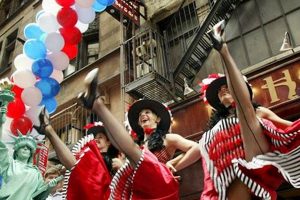
Bastille Day, celebrated annually on July 14th, commemorates a pivotal moment in the French Revolution. The day is marked by festivities that include military parades, concerts, and fireworks displays. The occasion offers an opportunity to reflect on the ideals of liberty, equality, and fraternity that underpin French national identity. Understanding the specific, lesser-known details surrounding this event can provide a richer appreciation of its historical significance.
Recognition of the day’s events highlights the evolution of France towards a republic. It serves as a reminder of the struggle for citizen rights and the overthrow of absolute monarchy. Examining the traditions associated with the celebration reveals how the original historical event has been interpreted and re-interpreted over time, reinforcing national unity and civic pride.
Further exploration of specific details uncovers intriguing aspects related to the storming of the Bastille, the subsequent political ramifications, and the evolution of the celebrations into the modern-day national holiday observed globally. These interesting tidbits provide insight into the day’s enduring legacy and its impact on the world.
Tips for Appreciating Bastille Day
These insights offer a deeper understanding of Bastille Day, encouraging informed participation in the celebrations and commemorations.
Tip 1: Research the Precursors to the Storming of the Bastille: Gain a comprehensive understanding of the socio-political climate in late 18th-century France. Examining the economic hardships, social inequalities, and Enlightenment ideals provides context for the events of July 14, 1789.
Tip 2: Explore the Symbolism of the Bastille: Understand why the Bastille, a medieval fortress used as a state prison, became a target for revolutionaries. It symbolized royal authority and arbitrary detention, representing the oppressive nature of the monarchy.
Tip 3: Differentiate Myth from Reality: Dispel common misconceptions about the storming of the Bastille. For example, few prisoners were actually held within the fortress at the time of its capture, yet its symbolic value remained immense.
Tip 4: Investigate the Roles of Key Figures: Research individuals who played pivotal roles during the revolution. Understanding the actions and motivations of figures like Louis XVI, Maximilien Robespierre, and Marquis de Lafayette provides a more nuanced perspective.
Tip 5: Trace the Evolution of the Celebration: Investigate how Bastille Day celebrations have changed over time. Comparing historical accounts of early commemorations with modern festivities reveals the evolving national identity and the meaning ascribed to the holiday.
Tip 6: Learn About the “La Marseillaise”: Understand the origin and significance of the French national anthem, “La Marseillaise.” Originally a revolutionary war song, its lyrics and melody reflect the fervor and ideals of the French Revolution and are central to Bastille Day commemorations.
Tip 7: Consider the Global Impact of the French Revolution: Reflect on how the events of the French Revolution influenced subsequent political movements and revolutions worldwide. Its emphasis on liberty, equality, and fraternity resonated far beyond France’s borders.
These insights offer a foundation for a more meaningful engagement with the history and significance of Bastille Day. They promote a deeper connection to the values that underpin the French Republic and their enduring relevance.
By adopting these tips, one can cultivate a more complete appreciation for the historical, cultural, and political importance of Bastille Day.
1. Prisoners

The assertion “Prisoners: Seven” is often cited among interesting details pertaining to Bastille Day. This data point provides a contrasting perspective to the common perception of the Bastille as a heavily populated prison, challenging conventional understanding and prompting further inquiry into the event’s true nature.
- Identity of the Prisoners
The seven prisoners held within the Bastille comprised four forgers, an Irish nobleman accused of insanity, and two individuals implicated in “immoral” acts as defined by the standards of the time. Their backgrounds reveal that the Bastille primarily housed individuals whose imprisonments were often based on factors beyond simple political dissidence, complicating the narrative of pure political oppression.
- Symbolic vs. Practical Significance
The small number of prisoners highlights the symbolic rather than the practical importance of the Bastille’s storming. While the revolutionaries aimed to liberate those unjustly imprisoned, the fortress’s greater significance lay in representing royal authority and the potential for arbitrary detention, regardless of the actual number of inmates.
- Impact on Public Perception
The discrepancy between the perceived and actual number of prisoners illustrates how historical events can be shaped by public imagination and propaganda. The storming of the Bastille became a powerful symbol of popular resistance, even if the immediate objective of prisoner liberation was not as significant as the symbolic blow against the monarchy.
- Historical Interpretation
The “Prisoners: Seven” data invites reevaluation of traditional narratives surrounding the French Revolution. It suggests a more nuanced understanding of the historical context, acknowledging that while the Bastille was a symbol of oppression, its actual function as a prison was more complex than commonly portrayed.
The detail regarding the seven prisoners underscores the need for careful examination of historical narratives. While their number may seem insignificant, their circumstances and the symbolic importance of the Bastille in the broader context of the French Revolution continue to fuel both academic and popular interest in this pivotal event. It also serves as a reminder that historical accuracy and symbolic interpretation can often diverge, shaping collective memory and influencing subsequent political discourse.
2. Symbol
The enduring connection between “Symbol: Liberty” and Bastille Day stems from the historical context of the storming of the Bastille itself. The Bastille, initially a medieval fortress, had become a state prison representing the arbitrary power of the monarchy. Its capture by revolutionary forces was less about freeing many prisoners (as previously mentioned, only seven were incarcerated at the time) and more about dismantling a potent emblem of royal authority and oppression. This act directly challenged the existing power structure and signaled a shift toward individual and collective freedom, thus solidifying “liberty” as a central ideal of the French Revolution. This is exemplified in subsequent declarations of rights and the evolving political landscape that prioritized citizen rights over monarchical decree.
The importance of “Symbol: Liberty” as a component of Bastille Day manifests in various forms of commemoration. The tricolor flag, a visual representation of liberty, equality, and fraternity, is prominently displayed. Parades, speeches, and artistic performances often emphasize the values of freedom and self-determination, reinforcing the link between the historical event and the abstract concept. For example, the military parade on the Champs-lyses, a highly visible event, serves not only as a display of national strength but also as a reminder of the sacrifices made in pursuit of liberty. The singing of “La Marseillaise”, the national anthem, further underscores this association, as its lyrics explicitly invoke themes of liberation and resistance against tyranny.
Understanding the symbiosis between Bastille Day and the “Symbol: Liberty” allows for a more nuanced appreciation of its significance. It transcends a simple historical recounting and underscores the enduring relevance of the values at its core. While the challenges of achieving true liberty persist across societies, the holiday acts as a reminder of the ongoing struggle and the importance of safeguarding fundamental freedoms. By recognizing this connection, individuals can move beyond mere observance and engage with the holiday as a potent expression of shared ideals and a call to action for the preservation and expansion of liberty.
3. Revolution
The assertion that the French Revolution represents a turning point in European history is inextricably linked to the specific details that constitute the Bastille Day narrative. The storming of the Bastille, a key event commemorated on this day, served as a catalyst for widespread social and political upheaval. Prior to July 14, 1789, the French monarchy maintained significant control, albeit with growing discontent. The successful attack on the Bastille, regardless of the number of prisoners freed, demonstrated the vulnerability of royal authority and emboldened revolutionary forces. This single act fundamentally altered the power dynamic, leading to the eventual overthrow of the monarchy and the establishment of a republic. Therefore, understanding the revolution as a turning point is crucial for appreciating the historical weight embedded within the interesting details of Bastille Day.
The importance of the “Revolution: Turning point” component for interpreting aspects of the Bastille Day celebration becomes apparent when considering its practical implications. Modern-day commemorations, such as the military parade and public speeches, consistently emphasize the ideals of liberty, equality, and fraternity, which emerged as direct consequences of the revolution. These ideals, which continue to shape French national identity and political discourse, are a direct result of the shift in power initiated by the events of 1789. Further, the revolution inspired similar movements for social and political change across Europe and the world. The recognition of this event as a turning point helps to assess the continuing influence of the revolution on global political thought.
In summary, the French Revolution, as epitomized by the storming of the Bastille and commemorated on Bastille Day, stands as a significant turning point. The acknowledgement of this paradigm shift enriches the understanding of the historical event and illuminates the meaning and context behind contemporary celebrations. Understanding this connection offers insights into the ongoing influence of the French Revolution’s ideas on freedom and equality and their lasting impact on political landscapes worldwide.
4. Celebration

The status of Bastille Day as a national holiday solidifies its importance in French national identity and collective memory. This designation guarantees an annual, nationwide commemoration of the storming of the Bastille, a pivotal event within the French Revolution. The official status leads to the allocation of resources for parades, fireworks displays, public speeches, and other festivities, ensuring the event remains at the forefront of the national consciousness. The interesting and sometimes lesser-known details surrounding the storming of the Bastille are thus perpetually interwoven with the broader narrative of national identity. The association with a national holiday necessitates the continued retelling of these events, guaranteeing the survival and transmission of key aspects from one generation to the next.
The act of celebrating Bastille Day as a national holiday prompts a re-examination of the events that transpired and their subsequent impact. For instance, the origin of the tricolor flag, the meaning behind “La Marseillaise”, and the actual composition of the revolutionary forces are frequently highlighted. These lesser-known details gain prominence during the national celebration, facilitating an in-depth understanding of the period. The televised military parade, for example, often features historical reenactments and commentary, underscoring the revolution’s influence on modern French society. Public speeches by political leaders on Bastille Day frequently invoke revolutionary ideals, such as liberty, equality, and fraternity, linking contemporary issues to the historical context.
In conclusion, the designation of Bastille Day as a national holiday serves as a mechanism for perpetuating and disseminating the complexities associated with the storming of the Bastille. These intriguing details, often less known than the broader narrative, gain visibility through state-sponsored events and media coverage, fostering a richer and more comprehensive understanding of the French Revolution and its lasting impact on French society. This continued interaction with the past contributes to a strengthened sense of national identity and encourages a deeper engagement with the historical foundations of the French Republic.
5. "La Marseillaise"

The French national anthem, “La Marseillaise,” occupies a prominent position within the historical narrative and celebratory traditions surrounding Bastille Day. Its origins are closely tied to the revolutionary fervor that culminated in the storming of the Bastille, making its inclusion in any discourse on interesting details surrounding the holiday essential for a complete understanding.
- Composition and Revolutionary Origins
“La Marseillaise” was not originally intended as a national anthem. It was composed in Strasbourg in 1792 by Claude Joseph Rouget de Lisle, originally titled “Chant de guerre pour l’arme du Rhin” (War Song for the Army of the Rhine). The song gained popularity as it was sung by volunteers from Marseille marching to Paris during the French Revolution, hence its subsequent name. This origin underscores the spontaneous and grassroots nature of the revolutionary spirit, contrasting with official, state-sponsored compositions.
- Adoption as National Anthem
The anthem’s potent message and stirring melody led to its adoption as the French national anthem in 1795. Its lyrics call for citizens to rise against tyranny, solidifying its association with the ideals of liberty, equality, and fraternity that fueled the French Revolution. While temporarily banned during periods of restoration of the monarchy, it was permanently reinstated as the national anthem in 1879, demonstrating its enduring significance in French national identity.
- Symbolism and Interpretation of Lyrics
The lyrics of “La Marseillaise” are undeniably violent and invoke imagery of bloodshed and conflict. However, understanding these lyrics within the context of the French Revolution reveals their intent as a call to defend the newly won freedoms against internal and external threats. Phrases like “Aux armes, citoyens!” (To arms, citizens!) and references to “impure blood” reflect the perceived existential threat to the revolution and the need for unwavering resolve. Modern interpretations often acknowledge the historical context while emphasizing the anthem’s broader message of resistance against oppression.
- Performance and Rituals on Bastille Day
“La Marseillaise” is a central component of Bastille Day celebrations. It is performed at military parades, public ceremonies, and concerts throughout the country. The singing of the anthem evokes a sense of national unity and reminds citizens of the sacrifices made to secure their liberties. The performance of “La Marseillaise” on Bastille Day serves as a symbolic reaffirmation of the values that underpin the French Republic, connecting the historical events of the revolution to contemporary national identity.
In conclusion, “La Marseillaise” is far more than a simple song; it is a potent symbol of the French Revolution and its enduring ideals. Its history, lyrics, and performance during Bastille Day celebrations provide a deeper understanding of the historical context and cultural significance of this pivotal national holiday. Understanding the multifaceted relationship between “La Marseillaise” and Bastille Day enriches any exploration of interesting details surrounding this important event.
6. Bastille
The Bastille, a medieval fortress repurposed as a state prison in Paris, stood as a tangible representation of royal authority in pre-revolutionary France. Its association with arbitrary imprisonment and the suppression of dissent made it a potent symbol of the monarchy’s power. This connection is crucial for understanding many lesser-known yet significant aspects of Bastille Day and the events leading up to it.
- Symbol of Arbitrary Imprisonment
The Bastille was not merely a prison; it represented the King’s ability to detain individuals without due process. Letters de cachet, signed by the King, allowed for imprisonment based on royal decree, bypassing judicial proceedings. The actual number of prisoners held within the Bastille at any given time was often relatively small, but the potential for arbitrary confinement instilled fear and resentment among the populace, thereby amplifying the fortress’s symbolic significance.
- Physical Manifestation of Royal Power
The Bastille’s imposing structure, with its high walls, towers, and armaments, visually reinforced the monarchy’s dominance. Its strategic location in Paris served as a constant reminder of the King’s presence and control. This physical embodiment of power made the Bastille a target for revolutionaries seeking to dismantle the monarchy’s grip on the city.
- Target for Revolutionary Sentiment
As revolutionary fervor grew, the Bastille became a focal point for popular discontent. Its association with royal authority made it a natural target for those seeking to challenge the monarchy’s legitimacy. The storming of the Bastille was not solely about freeing prisoners; it was a symbolic assault on royal power, intended to dismantle a visible emblem of oppression.
- Impact on Post-Revolutionary Perceptions
The destruction of the Bastille after the revolution reinforced its symbolic significance. The stones from the fortress were repurposed as souvenirs, distributed among the populace as tangible reminders of the victory over royal authority. This act cemented the Bastille’s place in revolutionary mythology and ensured its enduring association with the overthrow of the monarchy.
In summary, the Bastille’s role as a symbol of royal authority is fundamental to understanding the complexities and significance of Bastille Day. The details surrounding its function, symbolic value, and eventual destruction provide valuable insights into the dynamics of the French Revolution and the enduring quest for liberty.
7. Impact
The French Revolution, ignited by events such as the storming of the Bastille, exerted a profound and lasting influence on global political movements. The revolution’s articulation of liberty, equality, and fraternity, and its challenge to absolute monarchy, resonated with populations seeking to overthrow oppressive regimes and establish more representative forms of government. Recognition of these global impacts enhances the comprehension of specific, sometimes overlooked, aspects of Bastille Day.
The revolution’s influence can be observed in numerous subsequent movements for political reform and national liberation. The Latin American wars of independence, for example, drew inspiration from the French Revolution’s ideals, with leaders such as Simn Bolvar explicitly referencing its principles in their struggle against Spanish colonial rule. Similarly, nationalist movements in Europe during the 19th century, striving for unification and self-determination, frequently invoked the revolutionary spirit of 1789. Even much later, anticolonial movements in Africa and Asia adopted elements of the French Revolution’s rhetoric to advocate for independence and self-governance. The impact of the revolution on global movements underscores the interconnectedness of historical events and the diffusion of ideas across national boundaries. The practical significance of understanding this lies in recognizing the enduring legacy of the French Revolution as a catalyst for social and political change worldwide.
In summary, the French Revolution, sparked by the storming of the Bastille, functioned as a catalyst for global political movements. The revolutionary ideals spread beyond French borders, inspiring struggles for independence, unification, and self-determination across continents. Acknowledging the revolution’s global impact provides a richer context for appreciating the lesser-known aspects of Bastille Day and understanding the lasting influence of this pivotal historical moment. The challenge is to critically assess the application and adaptation of revolutionary ideals in diverse cultural and political contexts, recognizing both their transformative potential and the complexities of their implementation.
Frequently Asked Questions about Bastille Day
The following section addresses common inquiries related to Bastille Day, offering factual information and clarifying potential misconceptions surrounding the holiday and its historical context.
Question 1: What specifically is commemorated on Bastille Day?
Bastille Day commemorates the storming of the Bastille on July 14, 1789. This event, although involving a limited number of prisoners, symbolized the end of royal authority and the beginning of the French Revolution.
Question 2: Is Bastille Day solely a celebration of the storming of the Bastille?
While the storming of the Bastille is the central event commemorated, Bastille Day also celebrates the broader values of the French Revolution: liberty, equality, and fraternity. It signifies the establishment of the French Republic and the triumph of citizen rights.
Question 3: Were there many prisoners held within the Bastille at the time of the storming?
No, only seven prisoners were held in the Bastille on July 14, 1789. Their identities included forgers, individuals deemed insane, and those imprisoned for offenses against morality. The relatively small number of prisoners highlights the symbolic, rather than practical, importance of the event.
Question 4: Why is “La Marseillaise” associated with Bastille Day?
“La Marseillaise,” the French national anthem, originated during the French Revolution. Its lyrics embody the revolutionary spirit and call for citizens to defend liberty against tyranny. Its performance is central to Bastille Day celebrations.
Question 5: Did the storming of the Bastille immediately lead to the end of the monarchy?
While the storming of the Bastille was a pivotal event, the transition to a republic was gradual. The monarchy continued for several years after 1789, although with diminished power. The complete abolition of the monarchy and the establishment of the First French Republic occurred in 1792.
Question 6: Is Bastille Day celebrated only in France?
While Bastille Day is a national holiday in France, it is also celebrated in many countries around the world as a symbol of freedom and resistance against oppression. Celebrations outside of France often focus on promoting French culture and strengthening diplomatic ties.
Understanding these frequently asked questions provides a solid foundation for appreciating the historical significance of Bastille Day and dispelling common misconceptions.
Consider these insights when participating in or reflecting upon Bastille Day celebrations.
Conclusion
This exploration of fun facts about Bastille Day has illuminated various facets of this pivotal historical event. From the limited number of prisoners actually held in the Bastille to the global impact of the French Revolution, a deeper understanding of these details allows for a more nuanced appreciation of the holiday’s significance.
Bastille Day serves as a reminder of the enduring quest for liberty, equality, and fraternity. Continued engagement with its history and the ideals it represents remains essential for fostering informed citizenship and promoting a more just and equitable world.
![French Holiday: Is It Bastille Day Today? [Guide] | Hubbastille: Explore the Fusion of Culture, Music & Creativity](https://hubbastille.com/wp-content/uploads/2026/05/th-190-300x200.jpg "French Holiday: Is It Bastille Day Today? [Guide] Hubbastille: Explore the Fusion of Culture, Music & Creativity")