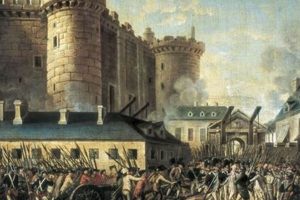
Victor Hugo’s Les Misrables is a historical novel that depicts France during the 19th century, spanning from the post-Napoleonic era through the June Rebellion of 1832. While the narrative encompasses significant historical events, including the societal aftermath of the French Revolution, it does not directly center on the storming of the Bastille, which occurred on July 14, 1789. This event, a pivotal moment in the French Revolution, predates the timeline of the primary narrative.
The significance of the novel lies in its portrayal of the struggles of the impoverished and marginalized within French society. It illuminates themes of injustice, redemption, and the enduring human spirit through the lives of its characters. Understanding the broader historical context of 19th-century France, including the social and political upheavals following the French Revolution, is crucial for interpreting the novel’s themes and appreciating its commentary on societal inequalities. The book illustrates the long-lasting repercussions of revolutionary fervor and its impact on the lives of ordinary citizens.
Therefore, the association with an earlier revolutionary event is indirect. The novel uses subsequent uprisings as a backdrop to examine broader questions of justice, law, and the possibility of societal transformation. These themes are explored through individual stories set against a politically charged landscape.
Guidance for Understanding Historical Context in Les Misrables
Analyzing Les Misrables effectively requires a nuanced understanding of the historical events that shaped Victor Hugo’s narrative. The following tips offer guidance in interpreting the novel’s social and political commentary.
Tip 1: Focus on the July Revolution of 1830 and the June Rebellion of 1832. These events serve as key historical backdrops against which the individual stories of characters like Jean Valjean, Cosette, and Marius unfold. Comprehending the causes and consequences of these uprisings provides essential context for the novel’s exploration of social unrest.
Tip 2: Recognize the influence of the French Revolution on 19th-century French society. While the novel does not directly depict the storming of the Bastille, the ideals and repercussions of the French Revolution permeate the societal structures and individual beliefs portrayed in the book. Acknowledging this influence is essential for understanding the characters’ motivations and the overarching themes of justice and equality.
Tip 3: Investigate the social and economic disparities of the era. Les Misrables vividly depicts the stark inequalities that plagued French society, with a significant portion of the population living in abject poverty. Exploring the historical context of these disparities enhances comprehension of the characters’ struggles and the novel’s critique of social injustice.
Tip 4: Examine the political climate following the restoration of the monarchy. The novel is set during a period of political instability, marked by shifts in power and ideological conflicts. Understanding the political landscape of the time allows for a deeper appreciation of the characters’ involvement in revolutionary movements and their hopes for societal change.
Tip 5: Consider the role of romanticism in shaping Hugo’s portrayal of historical events. As a prominent figure in the Romantic movement, Hugo infused his narrative with emotional intensity and a focus on the experiences of ordinary individuals. Recognizing the influence of romanticism enhances understanding of the novel’s depiction of historical events through a subjective and often idealized lens.
Tip 6: Research the significance of legal and penal systems of 19th-century France. Jean Valjean’s persecution highlights the rigid and often unjust legal system. Study of this system demonstrates its impact on the lives of the marginalized and oppressed. This research should include the concept of parole, its implementation and the limited support offered upon release.
Historical understanding enriches the experience of reading Les Misrables. Appreciating these historical aspects enables a more profound analysis of its enduring themes.
These insights allow a deeper understanding of Les Miserables beyond a simple narrative.
1. Historical setting

The temporal distance between the French Revolution (1789), specifically the storming of the Bastille, and the historical setting of Les Misrables (1815-1832) establishes a definitive disconnect between the novel’s core narrative and that seminal revolutionary event. The period 1815-1832 encompasses the Bourbon Restoration and the July Monarchy, characterized by specific social, political, and economic realities distinct from those leading to the storming of the Bastille. Consequently, while the French Revolution undeniably influenced subsequent French history, it does not constitute the direct subject matter of Hugo’s work. The concerns of the characters within Les Misrables stem from the conditions of 19th-century France, including poverty, social injustice, and political unrest specific to that era.
The significance of understanding this chronological distinction lies in correctly interpreting the novel’s themes and messages. Attributing the focus of Les Misrables to the events of 1789 would be historically inaccurate and would misrepresent Hugo’s commentary on the social and political landscape of post-Napoleonic France. The novel does feature insurrection and rebellion, most notably the June Rebellion of 1832, however these events are a result of factors specific to the July Monarchy, such as economic hardship, political discontent, and the lingering revolutionary ideals, and should not be confused as a direct continuation of the events surrounding the Bastille. The earlier revolutionary fervor set a precedent for future uprisings, but Les Misrables examines how these sentiments evolved and manifested in a different historical context.
In conclusion, the historical setting of 1815-1832 places Les Misrables firmly within a distinct period of French history, one that follows the French Revolution and is shaped by its aftermath, rather than depicting the events of 1789 directly. Recognizing this chronological separation is crucial for accurately understanding the novel’s narrative focus and its commentary on the social and political issues prevalent during the Bourbon Restoration and the July Monarchy. The setting becomes a crucial point for this novel to have its own identity and story telling narrative.
2. Bastille Day
Bastille Day, commemorating the storming of the Bastille on July 14, 1789, holds immense symbolic weight as a catalyst of the French Revolution. This event, signifying popular resistance to royal authority, ignited a period of radical social and political upheaval. While Les Misrables does not directly depict the events of 1789, the French Revolution, set in motion by events like the storming of the Bastille, functions as a foundational historical event that casts a long shadow over the 19th-century society portrayed in the novel. The revolutionary ideals of liberty, equality, and fraternity, born from the fervor of 1789, permeated French society and continued to influence political discourse and social movements throughout the period in which the story is set.
The connection between Bastille Day (1789) and the historical context of Les Misrables is one of cause and effect. The French Revolution, triggered by the storming of the Bastille, created a ripple effect across subsequent decades, shaping the social and political landscape in which the characters of Hugo’s novel live and struggle. The novel depicts the consequences of the revolution, including the rise and fall of Napoleon, the Bourbon Restoration, and the continued tension between revolutionary ideals and conservative forces. These are the conditions that lead to the events of 1832. The storming of the Bastille may not be depicted but continues to linger in its effects.
In conclusion, while Les Misrables is not directly about Bastille Day, understanding the historical significance of July 14, 1789, is crucial for comprehending the novel’s deeper themes and its portrayal of 19th-century French society. Bastille Day represents the genesis of the revolutionary spirit that continues to resonate throughout the historical period captured in Hugo’s work, highlighting the complexities and long-term ramifications of revolutionary change, and also providing the cultural framework for events of 1832 to make sense to both the audience and the characters. Understanding the role of the storming of the Bastille as a foundational event is essential for a comprehensive appreciation of the novel’s historical context.
3. Focus
The thematic core of Les Misrables resides in its unflinching examination of social injustice within 19th-century France. While the novel is not centered on the specific events of Bastille Day (1789), the societal conditions that fueled the French Revolution namely, systemic inequality and oppression remain central to Hugo’s narrative. The storming of the Bastille was itself a consequence of perceived injustices, including economic disparity, political marginalization, and the arbitrary exercise of power by the monarchy. Therefore, “social injustice” serves as a connecting thread, albeit indirect, between the historical backdrop of the French Revolution and the thematic concerns of Les Misrables. The social issues remain, just with a different monarchy. The key figures of the French Revolution, like Robspierre, are no longer there to voice concern.
The practical significance of understanding this connection lies in recognizing that the seeds of revolution often germinate in environments of profound social inequity. Les Misrables presents a microcosm of this dynamic, portraying the desperation and marginalization that can drive individuals to acts of rebellion. The characters’ struggles reflect the enduring legacy of unresolved societal issues stemming from the pre-revolutionary era. Jean Valjean’s experience as a convict highlights the harshness of the justice system and its disproportionate impact on the poor. Cosette’s exploitation underscores the vulnerability of children in a society marked by economic hardship. These specific instances of exploitation and abuse reflect the broader systemic problems that underpinned the French Revolution, albeit several decades later. These same problems create and reinforce that class divide. Because the conditions in France have remained relatively similar, conditions are ripe for an uprising.
In summary, while Les Misrables does not directly recount the events of Bastille Day, the underlying theme of social injustice serves as a vital link between the historical conditions that sparked the French Revolution and the societal issues explored within the novel. This understanding allows for a more nuanced appreciation of Hugo’s commentary on the enduring consequences of inequality and the cyclical nature of social unrest. The narrative emphasizes that the fundamental drivers of revolutionary movements, such as systemic injustice and economic disparity, can persist across historical periods, ultimately shaping individual lives and collective destinies. Further, the novel emphasizes that, if the causes for such revolutions remain, that another revolution may be just around the corner.
4. Insurrection, not revolution

The distinction between an insurrection and a revolution is crucial for understanding the relationship, or lack thereof, between Les Misrables and Bastille Day. While the storming of the Bastille on July 14, 1789, constituted a revolution, the events depicted in Hugo’s novel, particularly the June Rebellion of 1832, are more accurately categorized as an insurrection. This distinction is significant because it highlights the scope and aims of the respective movements, influencing their historical impact and thematic resonance.
- Scope of Change
A revolution seeks to fundamentally transform the existing power structures and societal norms, leading to a comprehensive restructuring of political, social, and economic systems. The French Revolution, with its overthrow of the monarchy and the establishment of a republic, exemplifies such a transformative change. Conversely, an insurrection is a localized or contained uprising against authority, often aimed at addressing specific grievances or achieving limited objectives. The June Rebellion in Les Misrables, while fueled by discontent, did not aim to dismantle the entire French government but rather to express dissatisfaction with the existing regime and its policies. This contrast in scope directly impacts the portrayal of historical events in Les Misrables, distancing it from the broader revolutionary fervor of the Bastille era.
- Political Objectives
Revolutions are typically driven by overarching ideologies and a desire for systemic change, such as the establishment of democratic principles or the overthrow of an oppressive regime. The storming of the Bastille was motivated by a desire for liberty, equality, and fraternity, embodying a comprehensive vision for a new social order. In contrast, an insurrection often lacks a clearly defined political program or a cohesive ideology. The June Rebellion, as depicted in Les Misrables, was characterized by a more amorphous sense of discontent and a desire for redress of specific grievances, rather than a unified vision for a fundamentally altered political system. This distinction reinforces the idea that the novel’s focus lies on localized struggles rather than a wholesale societal transformation reminiscent of the storming of the Bastille.
- Lasting Impact
Revolutions typically leave a lasting impact on the course of history, reshaping nations and altering the global balance of power. The French Revolution, with its influence on subsequent political movements and the spread of democratic ideals, exemplifies such a transformative historical event. An insurrection, on the other hand, often has a more limited and localized impact. While the June Rebellion in Les Misrables holds symbolic significance as a representation of popular resistance, it did not fundamentally alter the political landscape of 19th-century France. This difference in historical impact further distinguishes the novel from the revolutionary period triggered by the storming of the Bastille, emphasizing its focus on the experiences of individuals caught within the confines of a specific, contained uprising.
- Narrative Purpose
The portrayal of the June Rebellion as an insurrection, rather than a revolution, serves a specific narrative purpose within Les Misrables. Hugo uses the uprising to highlight the themes of social injustice, sacrifice, and the enduring human spirit, rather than to provide a comprehensive account of a transformative political event. The limited scope of the insurrection allows Hugo to focus on the individual experiences of his characters and to explore the moral complexities of revolutionary action. The historical revolution of 1789 then serves as an important backdrop to the localized conditions shown within Les Misrables. This focus on the human dimension of conflict further differentiates the novel from the grand historical narrative of the French Revolution and its iconic symbol, the storming of the Bastille.
The distinction between insurrection and revolution clarifies why Les Miserables, although set against a backdrop of political unrest and societal change, is not fundamentally about Bastille Day. While the ideals sparked in 1789 resonate throughout French society, the June Rebellion represents a different kind of conflict. This key difference in the scope and nature of the events highlights the localized and specific nature of events within Les Miserables and differentiates them from the larger historical revolution.
5. Hugo

Victor Hugo’s literary style, often described as “Romanticized realism,” significantly shapes the portrayal of historical events and social conditions within Les Misrables. This approach blends Romantic ideals of emotional intensity, individual heroism, and the power of the human spirit with a realistic depiction of the harsh realities of 19th-century France. Understanding this style is essential for interpreting the novel’s relationship to actual historical events, including the French Revolution and, specifically, whether the book is primarily about Bastille Day.
- Emotional Intensity and Historical Accuracy
Hugo’s Romantic sensibility infuses the narrative with heightened emotionality, often focusing on the suffering and resilience of the marginalized. While striving for historical accuracy, he also employs artistic license to amplify the emotional impact of events. For instance, the June Rebellion is depicted with dramatic flair, emphasizing the courage of the revolutionaries and the brutality of the government forces. However, it also presents the setting of the time period so the audiences is able to experience what it was like during the June Rebellion. This tension between historical fidelity and emotional amplification affects the novel’s portrayal of events, potentially overshadowing a strict adherence to historical timelines or political nuances. The realism, however, makes a world for the romantics to live within the text. The emotional intensity brings focus to those living through this period of upheaval.
- Idealized Heroism and Social Critique
Hugo’s characters often embody idealized traits, such as unwavering moral conviction or self-sacrificing heroism. Jean Valjean’s transformation and his relentless pursuit of redemption exemplifies this tendency. However, this focus on individual heroism does not preclude a sharp critique of social injustice. Hugo uses the characters’ experiences to expose the systemic inequalities and the dehumanizing effects of poverty and oppression. He also uses these characters as conduits to reveal the problems within a society as they are living in it.
- Symbolic Representation and Historical Context
Hugo frequently employs symbolism to represent broader historical and social forces. The barricade, for instance, functions as a potent symbol of resistance against oppression and the yearning for a more just society. While these symbols are rooted in the historical context of 19th-century France, they also transcend specific events, becoming universal representations of human struggles for freedom and equality. As the audience continues to witness the oppression within Les Miserables, the history of the Storming of the Bastille can continue to weigh on the reading audience and remind them of other times society has stood up to their oppressors. Understanding how characters and themes connect to past rebellions becomes a thematic connection.
- Didactic Purpose and Historical Narrative
Hugo had a clear didactic purpose in writing Les Misrables: to expose social injustices and inspire change. The narrative functions as both a historical account and a social commentary, blending factual details with moral pronouncements. While Hugo meticulously researched the historical events of his time, his interpretation of these events is shaped by his own political and social beliefs. Therefore, the novel should be approached as a work of art with its own unique perspective on history, rather than as a strictly objective historical document. This is not a revolution documentary, it has been fictionalized for greater effect. He has a goal with this book and the telling of events will further his goal.
In conclusion, Hugo’s “Romanticized realism” significantly influences the connection between Les Misrables and historical events, including the storming of the Bastille. While the novel provides a detailed depiction of 19th-century France, it does so through a lens of heightened emotionality, idealized heroism, and symbolic representation. This stylistic approach allows Hugo to explore universal themes of social justice and human resilience, while also offering a critique of the specific historical conditions of his time. His goal is not to focus on the events of Bastille Day itself. Understanding Hugo’s method is essential for appreciating the novel’s complex relationship to historical reality, separating historical fact from artistic interpretation.
Frequently Asked Questions
The following questions address common points of confusion regarding the historical context of Victor Hugo’s Les Misrables and its connection, or lack thereof, to the storming of the Bastille.
Question 1: Is Les Misrables a historical account of the storming of the Bastille?
No, Les Misrables is not a direct historical account of the storming of the Bastille (July 14, 1789). The novel’s primary timeline spans from 1815 to 1832, encompassing the Bourbon Restoration and the June Rebellion. The Bastille event predates the narrative’s main action.
Question 2: Does Bastille Day feature prominently within the plot of Les Misrables?
No, Bastille Day does not feature prominently within the plot. The events of July 14, 1789, are not directly depicted or explicitly discussed as a central element of the story.
Question 3: Does the French Revolution influence the events and themes of Les Misrables?
Yes, the French Revolution, sparked by events like the storming of the Bastille, profoundly influences the events and themes of Les Misrables. The novel explores the long-term social and political consequences of the revolution and its ideals, specifically the continued struggle between those ideals and the restored monarchy. The conditions in France following the Bastille play an important part in setting the stage for the characters and situations explored by Hugo.
Question 4: Is the June Rebellion of 1832 a continuation of the French Revolution?
The June Rebellion of 1832, depicted in Les Misrables, is not a direct continuation of the French Revolution. It represents a separate, albeit related, uprising driven by specific grievances and political conditions of the July Monarchy. While inspired by revolutionary ideals, it was a more localized and contained event.
Question 5: Does Victor Hugo portray the French Revolution in a positive light?
Victor Hugo’s portrayal of the French Revolution is complex. While he embraces its ideals of liberty, equality, and fraternity, he also acknowledges the violence and excesses that occurred during the revolutionary period. The novel is a mixed reflection of the revolution. This is partly due to the time that has elapsed since the initial revolution and Hugo’s proximity to the more recent June Rebellion.
Question 6: Does the novel offer any insights into revolutions generally?
Yes, the novel offers insights into the nature of revolutions. Revolutions come from an overwhelming sense of injustice among the populace. Revolutions might not fix every problem and can lead to as many problems as they solve. And revolutions are often built by idealists with noble goals who may not grasp the practicality of enacting change. Lastly, the novel suggests that the seeds of revolution are always present as long as there is injustice. Revolutions are not one-time events, but rather cyclical.
In summary, Les Misrables is not explicitly about Bastille Day, but the French Revolution and its aftermath are crucial for understanding the novel’s historical context and thematic concerns. The connection is one of consequence and influence rather than direct depiction.
Consider these FAQs for a nuanced understanding of the historical backdrop of Les Misrables.
Concluding Assessment
This analysis confirms that Les Misrables does not directly recount the events of Bastille Day. The narrative’s timeline occurs after this pivotal moment in the French Revolution. The focus rests instead upon the social and political conditions of 19th-century France, specifically the Bourbon Restoration and the July Monarchy. While the ideals and consequences of the French Revolution influence the characters and themes within Hugo’s work, Bastille Day itself remains outside the immediate scope of the story.
A comprehensive understanding of historical context necessitates recognizing the nuanced relationship between Les Misrables and earlier revolutionary events. While not the subject of the narrative, the seeds of social unrest and the pursuit of justice, sown in 1789, continue to resonate throughout the lives and struggles depicted by Hugo. Continued study of these historical interconnections will enable a deeper appreciation for the lasting impact of revolutions on societies and individuals.
![French Holiday: Is It Bastille Day Today? [Guide] | Hubbastille: Explore the Fusion of Culture, Music & Creativity](https://hubbastille.com/wp-content/uploads/2026/05/th-190-300x200.jpg "French Holiday: Is It Bastille Day Today? [Guide] Hubbastille: Explore the Fusion of Culture, Music & Creativity")