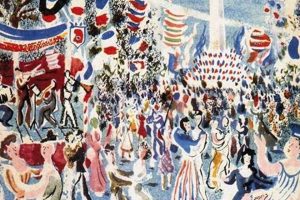
The event commemorated annually on July 14th marks a pivotal moment in French history: the storming of a medieval fortress and prison in Paris. This action, while not solely about freeing prisoners (there were relatively few incarcerated at the time), symbolized a broader challenge to royal authority and the perceived injustices of the Ancien Rgime. The event provided revolutionary forces with a tangible victory and valuable resources, specifically gunpowder stored within the structure.
The significance of this event lies in its galvanizing effect on the burgeoning French Revolution. It represented a shift in power from the monarchy to the people, fueling further revolutionary fervor throughout France. Its impact extends beyond France, serving as a symbol of popular resistance against oppressive regimes and inspiring movements for liberty and self-determination worldwide. The symbolic destruction of this edifice, a representation of royal power, resonated deeply with those seeking societal change and equality.
Understanding the causes and consequences of this event is crucial for grasping the complexities of the French Revolution. This examination includes exploring the socio-economic conditions that preceded it, the key figures involved, and the subsequent political and social transformations that reshaped France and Europe.
Understanding the Historical Event
Examining the roots of this historical event requires careful attention to detail and a nuanced understanding of the political, social, and economic landscape of late 18th-century France. The following points offer guidance for a comprehensive analysis.
Tip 1: Contextualize the Socio-Economic Conditions: Explore the widespread economic hardship, social inequality, and political discontent that fueled revolutionary sentiment. Understand the burden of taxation on the Third Estate and the privileges enjoyed by the aristocracy and clergy.
Tip 2: Analyze the Role of the Enlightenment: Investigate how Enlightenment ideals of liberty, equality, and popular sovereignty influenced revolutionary thinkers and fueled calls for political reform. Examine the works of philosophers such as Rousseau, Voltaire, and Montesquieu.
Tip 3: Scrutinize Royal Authority and Mismanagement: Assess the perceived weakness and incompetence of King Louis XVI and the perceived extravagance of the royal court. Analyze how royal policies contributed to the financial crisis and exacerbated popular discontent.
Tip 4: Investigate the Preceding Events: Understand the significance of events leading up to the event, such as the calling of the Estates-General, the Tennis Court Oath, and the dismissal of Jacques Necker. These events created a volatile atmosphere and heightened tensions between the monarchy and the Third Estate.
Tip 5: Deconstruct the Event Itself: Analyze the motivations and actions of the participants. Consider the role of the Parisian populace, the National Guard, and other revolutionary factions. Evaluate the strategic importance of the captured supplies.
Tip 6: Evaluate the Symbolic Impact: Understand how the event became a potent symbol of popular resistance against tyranny and inspired revolutionary movements across Europe and beyond. Assess how it contributed to the dismantling of the Ancien Rgime.
Tip 7: Explore the Short-Term and Long-Term Consequences: Analyze how the event contributed to the escalation of the French Revolution and the Reign of Terror. Examine its long-term impact on French society, politics, and culture.
A thorough understanding requires acknowledging the multi-faceted nature of the event, moving beyond simplified narratives, and engaging with diverse historical perspectives.
Comprehending these elements provides a necessary foundation for exploring subsequent developments within the French Revolution and its far-reaching implications.
1. Political Unrest

Political unrest in pre-revolutionary France formed a crucial backdrop to the events that unfolded in July 1789. This unrest, fueled by a complex interplay of factors, directly contributed to the environment in which the storming of the Bastille became a pivotal act of defiance.
- Weakening of Royal Authority
The reign of Louis XVI was marked by indecisiveness and a perceived lack of leadership. His inability to address the mounting economic and social problems eroded public trust in the monarchy. This erosion of authority created a vacuum that revolutionary factions were eager to fill, fostering an environment of instability and challenge to the existing order.
- Paralysis of the Estates-General
The Estates-General, convened in 1789 after a long hiatus, was intended to address the growing crisis. However, the rigid social divisions and voting procedures within the Estates-General quickly led to deadlock. The Third Estate’s demands for fairer representation and meaningful reform were consistently blocked by the privileged orders, fueling frustration and a sense that change could only be achieved through more radical means.
- Rise of Revolutionary Factions and Ideas
The political climate fostered the growth of revolutionary factions, each with its own vision for the future of France. Groups like the Jacobins and Cordeliers emerged, advocating for more radical reforms and challenging the legitimacy of the monarchy. These groups, along with influential writers and thinkers, disseminated revolutionary ideas through pamphlets, newspapers, and public speeches, further galvanizing public opinion against the existing regime.
- Popular Mobilization in Paris
Paris became a hotbed of political activism. The city’s population, already burdened by economic hardship and food shortages, was increasingly receptive to revolutionary ideas. Public gatherings, demonstrations, and the formation of citizen militias became commonplace, creating a sense of collective empowerment and a willingness to confront royal authority directly. This mobilized populace provided the necessary force to carry out the assault on the Bastille.
The confluence of these aspects of political unrest created a highly volatile atmosphere in Paris. The perceived weakness of the monarchy, the failures of the Estates-General, the rise of revolutionary ideologies, and the mobilization of the Parisian populace all converged to create the conditions that made the event not only possible, but almost inevitable. The act, therefore, represents a direct consequence of the profound political instability that plagued France in the years leading up to 1789.
2. Social Inequality

Social inequality in pre-revolutionary France served as a primary catalyst for the events of 1789. The rigid hierarchical structure, inherited from feudal times, divided society into three Estates, each with distinct rights and obligations. This division fostered deep resentment and contributed directly to the revolutionary fervor that culminated in the storming of the Bastille. The First and Second Estates, comprised of the clergy and nobility respectively, enjoyed significant privileges, including exemption from most taxes. The Third Estate, encompassing the vast majority of the population from peasants and urban workers to merchants and professionals bore the brunt of the tax burden while having limited political representation. This disparity fueled a sense of injustice and fueled demands for equality.
The impact of this inequity extended beyond mere financial burdens. The nobility held exclusive rights to certain professions and positions of power, effectively limiting social mobility for those in the Third Estate. For example, a talented and ambitious commoner could be barred from high-ranking positions in the military or government solely based on their birth status. This systemic discrimination bred resentment and a desire for fundamental change. Furthermore, the clergy, despite its supposed spiritual role, often controlled vast landholdings and amassed wealth, further exacerbating the economic disparities. The perceived opulence of the elite classes, contrasted with the poverty and hardship faced by the majority of the population, created a stark visual representation of the inequality that fueled revolutionary sentiment.
In conclusion, social inequality was not merely a background condition but a central cause of the revolutionary upheaval. The storming of the Bastille can be interpreted as a direct consequence of the Third Estate’s rejection of the existing social order and its determination to achieve equality and justice. Understanding the dynamics of social inequality in pre-revolutionary France is, therefore, essential for comprehending the origins, course, and significance of the French Revolution.
3. Economic Hardship

Economic hardship in pre-revolutionary France constituted a critical element contributing to the conditions that precipitated the storming of the Bastille. This hardship manifested in several interconnected ways, creating a climate of widespread discontent and instability. A primary driver was the national debt, accrued through costly wars and lavish spending by the monarchy. The government’s inability to manage its finances resulted in heavy taxation, disproportionately burdening the Third Estate, while the privileged classes remained largely exempt. This financial strain limited economic opportunities and intensified poverty among the lower classes.
Compounding the fiscal crisis were a series of agricultural failures. Poor harvests in the years leading up to 1789 led to soaring food prices, particularly for bread, the staple food of the French population. These food shortages sparked riots and unrest in Paris and other urban centers, further destabilizing the political situation. The combination of high taxes, food scarcity, and unemployment created a desperate situation for many, making them receptive to revolutionary ideas that promised a better future. The storming of the Bastille can be seen, in part, as a desperate act fueled by economic desperation and a desire for access to resources, specifically the grain supposedly stored within the fortress.
In summary, economic hardship was not merely a backdrop to the events of 1789; it was a significant cause. The convergence of national debt, unfair taxation, agricultural failures, and food shortages created a volatile situation that fueled popular anger and contributed directly to the decision to confront royal authority. Understanding the economic context is essential for comprehending the motivations and actions of those who participated in the storming and for appreciating the broader significance of the French Revolution.
4. Royal Absolutism

Royal absolutism in 18th-century France provided the structural framework against which revolutionary sentiments coalesced, directly contributing to the events of 1789. The concentration of power in the monarchy, unchecked by representative institutions or legal constraints, fostered an environment of resentment and a perceived lack of accountability, ultimately leading to the challenge of royal authority. This concentration of power fueled revolutionary fervor.
- Unfettered Authority and Decision-Making
The French monarchy, under Louis XVI, held absolute authority, enabling the king to make laws, levy taxes, declare war, and administer justice without the consent of any representative body. This centralized decision-making, often perceived as arbitrary and detached from the needs of the populace, fueled a sense of powerlessness and resentment, particularly among the Third Estate. Examples include the imposition of heavy taxes without consultation and the maintenance of exorbitant royal spending amidst widespread poverty. These decisions, stemming directly from unchecked royal authority, exacerbated economic hardship and fueled calls for political reform.
- Suppression of Dissent and Political Opposition
Royal absolutism extended to the suppression of dissent and any form of political opposition. Freedom of speech and the press were curtailed, and critics of the monarchy faced imprisonment or exile. This stifling of political expression prevented open dialogue and reform, forcing opposition underground and fostering a climate of revolutionary conspiracy. The censorship of Enlightenment ideas, which challenged the legitimacy of absolute rule, further fueled resentment and contributed to the intellectual ferment that ultimately undermined the monarchy.
- System of Privilege and Social Hierarchy
Absolutism reinforced a rigid social hierarchy in which the nobility and clergy enjoyed significant privileges, including exemption from most taxes and preferential access to positions of power. This system of privilege, sanctioned by the monarchy, perpetuated social inequality and fueled resentment among the Third Estate, which bore the brunt of the tax burden and lacked political representation. The storming of the Bastille can be interpreted as a rejection of this system of privilege and a demand for equality before the law.
- Lack of Accountability and Transparency
The absence of accountability and transparency in royal governance further eroded public trust in the monarchy. Decisions were often made behind closed doors, without public scrutiny or explanation. This lack of transparency fueled suspicion and resentment, leading to accusations of corruption and mismanagement. The Bastille itself, a symbol of arbitrary royal power and imprisonment without due process, became a target of revolutionary anger due to its perceived connection to this lack of accountability.
In summary, royal absolutism provided the political context for the events of 1789. The unchecked authority of the monarchy, the suppression of dissent, the system of privilege, and the lack of accountability all contributed to a climate of resentment and ultimately led to the storming, a symbolic act of defiance against royal authority and a demand for fundamental political change.
5. Enlightenment Ideals and the Event

Enlightenment ideals served as a potent intellectual catalyst for the events of 1789. Philosophies championing reason, individual rights, and popular sovereignty directly challenged the legitimacy of the Ancien Rgime and its foundations of absolute monarchy and social hierarchy. Key Enlightenment thinkers such as John Locke, Jean-Jacques Rousseau, and Montesquieu articulated concepts that resonated deeply with segments of French society dissatisfied with the status quo. Locke’s emphasis on natural rights, Rousseau’s advocacy for the social contract and popular sovereignty, and Montesquieu’s theory of the separation of powers provided intellectual justification for the overthrow of a system deemed unjust and oppressive. The dissemination of these ideas through salons, pamphlets, and books created a climate of intellectual ferment and critical questioning of established authority.
The practical impact of Enlightenment ideals on the events can be observed in the demands articulated by the Third Estate during the Estates-General of 1789. Their calls for equal representation, voting by head rather than by order, and a written constitution directly reflected Enlightenment principles of equality, popular sovereignty, and limited government. Furthermore, the “Declaration of the Rights of Man and of the Citizen,” adopted shortly after the event, enshrined Enlightenment ideals of liberty, equality, and fraternity as fundamental principles of the new French nation. The document served as a blueprint for a more just and equitable society, directly inspired by Enlightenment philosophy. For example, the article guaranteeing freedom of speech and religion was a direct refutation of the censorship and religious intolerance characteristic of the Ancien Rgime. The importance of Enlightenment ideals lies in their ability to provide both a critique of the existing order and a vision for a better future.
In conclusion, the storming was not merely a spontaneous act of violence but a manifestation of deeper intellectual currents shaped by Enlightenment thought. Enlightenment ideals provided the ideological foundation for the challenge to royal authority and the demand for a more just and equitable society. Understanding this connection is crucial for grasping the full significance of the event as a pivotal moment in the French Revolution and a watershed in the history of modern political thought. While the path towards realizing these ideals proved complex and fraught with challenges, their influence on the course of the French Revolution and subsequent movements for liberty and democracy remains undeniable. The event demonstrated the power of ideas to mobilize populations and transform societies, highlighting the enduring legacy of the Enlightenment.
Frequently Asked Questions About the Origins of Bastille Day
This section addresses common inquiries and clarifies misconceptions regarding the historical context and significance of the event commemorated as Bastille Day.
Question 1: Was the primary purpose to liberate a large number of political prisoners?
The primary purpose was not the liberation of a large number of political prisoners. Historical records indicate that the fortress held a relatively small number of inmates at the time of the assault, few of whom were political prisoners. The acquisition of gunpowder and weapons stored within its walls and the symbolic challenge to royal authority were more significant motivators.
Question 2: Was the storming a spontaneous, unplanned event?
While the immediate trigger for the event may have been spontaneous, it was the culmination of weeks of escalating tensions and political mobilization. The Parisian populace, fueled by economic hardship and inspired by revolutionary rhetoric, had been actively seeking opportunities to challenge royal authority.
Question 3: Did the storming immediately lead to the end of the French monarchy?
The storming did not immediately lead to the end of the French monarchy. King Louis XVI remained in power for several years following the event, albeit under increasing pressure from revolutionary forces. The monarchy was formally abolished in 1792.
Question 4: Was the storming universally supported by all segments of French society?
The storming was not universally supported by all segments of French society. While it was embraced by many members of the Third Estate, particularly in Paris, some nobles and clergy remained loyal to the monarchy, and even within the Third Estate, there were varying degrees of support for radical change.
Question 5: Is the event primarily a celebration of violence and revolution?
The event is not primarily a celebration of violence and revolution, although those elements are undeniably part of its historical context. More broadly, it is a commemoration of the ideals of liberty, equality, and fraternity that underpinned the French Revolution and continue to resonate in French society.
Question 6: Is understanding the circumstances essential for understanding the subsequent course of the French Revolution?
Understanding the circumstances is essential for understanding the subsequent course of the French Revolution. The event marked a turning point in the revolution, demonstrating the power of popular mobilization and signaling the irreversible decline of royal authority. It set the stage for the more radical phases of the revolution, including the Reign of Terror.
In summary, the event of commemorated each July is complex, laden with significant political meanings and outcomes. Further exploration and evaluation is required to grasp the complexity of the event.
The next section delves into the lasting legacy and cultural impact of this pivotal occurrence.
Origins of Bastille Day
The preceding analysis underscores the multifaceted nature of the origins of Bastille Day. This pivotal moment in French history stemmed from a confluence of political, social, economic, and intellectual factors. Royal absolutism, social inequality, economic hardship, and the burgeoning ideals of the Enlightenment converged to create a climate ripe for revolution. The storming, therefore, represents not merely a singular event, but a culmination of long-simmering tensions and a symbolic challenge to the Ancien Rgime.
Continued examination of this transformative event remains vital for understanding the trajectory of the French Revolution and its enduring impact on concepts of liberty, equality, and national identity. Further research into primary sources and diverse historical interpretations is encouraged to foster a more nuanced and complete comprehension of this critical juncture in European history. Its influence continues to shape modern political discourse and societal values.