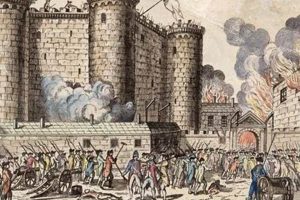
The narrative surrounding the events of July 14, 1789, chronicles a pivotal moment in French history. It details the storming of a Parisian fortress, a symbolic act of defiance against royal authority. This event, steeped in socio-political tension, signaled the beginning of widespread revolution and the decline of the ancien rgime. It’s a historical account marked by conflict, societal upheaval, and the pursuit of liberty.
The significance of this historical episode lies in its representation of popular sovereignty and the overthrow of oppressive structures. The repercussions of these events reverberated throughout Europe and beyond, inspiring movements for self-determination and democratic ideals. Its commemoration serves as a reminder of the enduring pursuit of freedom and the power of collective action to effect fundamental societal change. The benefits derived from understanding this period include a deeper appreciation for democratic principles and the fragility of established power.
The following sections will further examine the intricate details leading up to this key moment, explore the immediate aftermath, and analyze the long-term consequences that shaped France and influenced global political thought. The specific social, economic, and political grievances that fueled the revolutionary fervor will be discussed, as well as the various interpretations and historical debates surrounding the event.
Understanding the Historical Significance
Gaining a comprehensive understanding of the events surrounding the storming of the Bastille requires careful consideration of several key aspects. These insights can help one appreciate the complexities and enduring relevance of this pivotal moment in history.
Tip 1: Investigate the Pre-Revolutionary Context: A thorough examination of the socio-political climate in France leading up to 1789 is essential. Factors such as widespread famine, economic disparity, and the perceived extravagance of the monarchy contributed significantly to the unrest. Study the reign of Louis XVI and Marie Antoinette to understand their role in exacerbating tensions.
Tip 2: Explore the Concept of Absolutism: Understanding the principles of absolute monarchy and its limitations is critical. The perceived abuses of power by the ruling class fueled the desire for change. Research the philosophical challenges to absolutism during the Enlightenment.
Tip 3: Analyze the Role of the Enlightenment: Enlightenment ideals, such as liberty, equality, and fraternity, played a crucial role in shaping revolutionary thought. Study the works of influential Enlightenment thinkers like Rousseau, Voltaire, and Montesquieu to understand their impact on the French Revolution.
Tip 4: Examine the Symbolism of the Bastille: The Bastille represented royal authority and oppression. Its capture was not primarily about freeing prisoners (there were few at the time) but about dismantling a symbol of tyranny. Research the building’s history and its perception by the Parisian populace.
Tip 5: Understand the Short-Term Consequences: The storming of the Bastille had immediate repercussions, including the collapse of royal authority in Paris and the rise of popular power. Study the formation of the National Guard and the subsequent political reorganization of the city.
Tip 6: Analyze the Long-Term Impact: The events had a profound and lasting influence on France and Europe. The French Revolution led to the abolition of feudalism, the Declaration of the Rights of Man and of the Citizen, and the rise of republicanism. Research the Napoleonic era and its impact on the spread of revolutionary ideals.
By carefully considering these key insights, one can develop a deeper and more nuanced understanding of the intricate factors that contributed to, and the enduring legacy of, the tumultuous events. Comprehending the causes, consequences, and symbolism allows for a more informed perspective on the forces that shaped modern Europe.
The subsequent discussion will delve further into the specific historical figures, key events, and ongoing debates surrounding this transformative period.
1. Royal Authority and the Bastille

The concept of royal authority is inextricably linked to the narrative of the Bastille. In 18th-century France, the monarchy, embodied by King Louis XVI, held absolute power. This authority, legitimized by divine right, permeated every aspect of French society, from lawmaking and taxation to the administration of justice. The Bastille, a medieval fortress converted into a state prison, served as a potent symbol of this authority. It represented the king’s ability to imprison individuals arbitrarily, often without trial, based on lettres de cachet, sealed letters bearing the royal seal. These letters effectively circumvented due process and underscored the unchecked power vested in the crown.
The perceived abuses of royal authority, coupled with widespread economic hardship and social inequality, created a volatile environment ripe for revolution. The summoning of the Estates-General in 1789, intended to address the mounting fiscal crisis, instead became a forum for challenging the existing power structure. When the king resisted calls for reform and attempted to dissolve the National Assembly, popular discontent reached a boiling point. The storming of the Bastille on July 14, 1789, was not merely an attack on a prison; it was a direct assault on the symbol of royal authority and a declaration that the people of France would no longer tolerate unchecked power. The revolutionaries sought to dismantle the system that allowed for arbitrary imprisonment and to establish a government based on the principles of liberty, equality, and fraternity.
Understanding the relationship between royal authority and the events of July 14th provides a crucial perspective on the French Revolution. The storming marked a decisive shift in power, from the monarchy to the people, and signaled the end of absolute rule in France. The challenge to royal authority at the Bastille reverberated throughout Europe, inspiring similar movements for democratic reform and contributing to the decline of monarchical power across the continent. Analyzing this historical episode underscores the importance of checks and balances on governmental power and the enduring quest for individual liberties and justice.
2. Popular Uprising
The popular uprising of July 14, 1789, forms an integral chapter of the events. This surge of collective action was not a spontaneous occurrence but rather the culmination of years of socio-economic grievances, political disenfranchisement, and the burgeoning influence of Enlightenment ideals among the common populace. Its direct impact on the unfolding of the key event cannot be overstated.
- Economic Hardship and Social Inequality
Widespread poverty, coupled with a regressive tax system that disproportionately burdened the Third Estate (commoners), fueled immense resentment. Bread shortages and soaring prices intensified public anger, leading to frequent riots and demonstrations in Paris. The perceived indifference of the aristocracy to the plight of the common people further exacerbated tensions, creating a volatile atmosphere ripe for rebellion. This economic and social disparity provided the necessary impetus for mass mobilization.
- Political Disenfranchisement of the Third Estate
The Estates-General, a representative assembly of the French social classes, was convened in 1789 to address the nation’s fiscal crisis. However, the voting structure, which favored the privileged clergy and nobility, effectively silenced the voice of the Third Estate, representing the vast majority of the population. This political marginalization led to the formation of the National Assembly, a revolutionary body that aimed to draft a new constitution and assert the sovereignty of the people. The king’s attempt to suppress the National Assembly triggered widespread outrage and solidified popular support for radical action.
- Influence of Enlightenment Ideals
Enlightenment philosophers, such as Rousseau and Voltaire, championed principles of liberty, equality, and popular sovereignty, which resonated deeply with the French populace. These ideas circulated widely through pamphlets, newspapers, and public discussions, shaping public opinion and inspiring a desire for political reform. The concept of natural rights and the social contract provided a philosophical justification for challenging the legitimacy of the monarchy and demanding a more representative form of government. The dissemination of these ideals empowered the common people to articulate their grievances and envision a more just and equitable society.
- The Role of Parisian Mobs and Revolutionary Leaders
Parisian mobs, often comprised of sans-culottes (working-class citizens), played a crucial role in escalating the conflict. Driven by hunger, desperation, and revolutionary fervor, they engaged in direct action, such as looting, rioting, and ultimately, storming the Bastille. Charismatic revolutionary leaders, such as Camille Desmoulins, emerged as influential figures, mobilizing public opinion and directing the actions of the mob. These leaders provided the necessary organization and coordination for the popular uprising to achieve its objectives. The confluence of mob violence and leadership proved instrumental in achieving the immediate goals.
The convergence of economic hardship, political disenfranchisement, Enlightenment ideals, and the actions of Parisian mobs transformed simmering discontent into a full-fledged popular uprising. The events of July 14, 1789, were thus not an isolated incident but the direct consequence of deep-seated societal grievances and the collective determination of the French people to overthrow an oppressive regime. The storming represents a pivotal moment when popular will directly challenged and dismantled a symbol of absolute power.
3. Symbolic Defiance

The events surrounding the Bastille on July 14, 1789, are fundamentally intertwined with the concept of symbolic defiance. The act of storming the fortress-prison transcends a mere military objective; it represents a potent rejection of royal authority and the oppressive systems of the ancien rgime. The subsequent analysis explores facets of this defiance, highlighting their significance within the historical narrative.
- The Bastille as a Symbol of Tyranny
The Bastille served as a physical embodiment of royal power and arbitrary justice. Although housing relatively few prisoners at the time of its capture, its reputation as a place of confinement for political dissidents and those imprisoned by lettres de cachet made it a potent symbol of oppression. Attacking it was a direct challenge to the King’s authority and the unjust system it represented. This action signaled the end of acquiescence and the beginning of active resistance.
- Rejection of Absolute Monarchy
The storming was not simply about freeing prisoners; it was a rejection of the entire system of absolute monarchy. By taking control of the Bastille, the revolutionaries demonstrated their unwillingness to accept the unchecked power of the King and his administration. It was a declaration that sovereignty resided in the people, not in the crown. The very act was a forceful negation of the status quo, a tangible representation of the rising tide of revolutionary sentiment.
- Assertion of Popular Sovereignty
The individuals participating in the assault on the Bastille acted without official sanction or command. This underscored the burgeoning belief in popular sovereignty the idea that political power ultimately resides in the people. The storming demonstrated a willingness to take matters into their own hands, asserting their right to shape their own destiny and challenge established authority. This collective action effectively transferred power from the ruling elite to the citizens, emphasizing a monumental shift in the social construct.
- Inspiration for Further Revolution
The successful storming served as an inspiration for further revolutionary action. It demonstrated that the monarchy was not invincible and that popular uprisings could achieve tangible results. This success emboldened revolutionaries throughout France and beyond, contributing to the spread of revolutionary ideals and the eventual overthrow of other oppressive regimes. It became a rallying cry for those seeking liberty and self-determination, resonating far beyond the borders of France.
In conclusion, the symbolic defiance inherent in the events of the Bastille transcends the physical act of capturing a prison. It embodies a profound rejection of tyranny, an assertion of popular sovereignty, and a catalyst for broader revolutionary change. The historical value lies in its demonstration that the will of the people, when unified and resolute, can dismantle even the most formidable symbols of oppression. This potent act of defiance continues to resonate as a reminder of the enduring human quest for freedom and self-governance.
4. Political Turmoil

The narrative surrounding the events of July 14, 1789, is intrinsically linked to the pervasive political turmoil that gripped France during the late 18th century. This period, characterized by instability, dissent, and the erosion of established authority, provided the breeding ground for the revolutionary fervor that culminated in the storming of the Bastille. Understanding this turmoil is crucial for comprehending the significance.
- Weakening of Royal Authority
The reign of Louis XVI witnessed a steady decline in the prestige and authority of the monarchy. His perceived indecisiveness, coupled with the extravagance of the royal court, fueled public discontent. The king’s inability to effectively address France’s mounting economic problems further eroded his legitimacy. The royal family was widely seen as out of touch, which delegitimized the monarchy.
- Financial Crisis and Taxation
France faced a severe financial crisis, exacerbated by costly wars and inefficient taxation. The burden of taxation fell disproportionately on the Third Estate (commoners), while the nobility and clergy enjoyed significant exemptions. Attempts to reform the tax system were met with resistance from privileged groups, intensifying social unrest. This exacerbated existing tensions and created a volatile political climate.
- The Rise of the National Assembly
The summoning of the Estates-General in 1789 provided an opportunity for the Third Estate to voice its grievances and demand political reforms. When the king resisted these demands, the Third Estate formed the National Assembly, claiming the authority to represent the French nation. This act of defiance challenged the king’s absolute power and marked a turning point in the revolution. It showed the determination of the revolutionaries to change the course of the monarchy.
- Public Discontent and Riots
Years of economic hardship, food shortages, and political repression led to widespread public discontent. Riots and demonstrations erupted in Paris and other cities, reflecting the growing anger and frustration of the common people. The storming of the Bastille was one of the major outgrowths of this turmoil and indicated the growing chaos and anarchy in the society.
These elements of political turmoil, intertwined and mutually reinforcing, provided the essential context for the events of July 14, 1789. The Bastille was not simply an isolated incident but rather the culmination of years of political instability and social unrest. The actions of the people that day reflected a determination to fundamentally alter the power structure and usher in a new era of governance, highlighting the instability’s deep reaching effects.
5. French Revolution

The connection between the French Revolution and the Bastille event is one of cause and effect, and of symbol and substance. The storming of the Bastille on July 14, 1789, is considered a pivotal event that ignited the French Revolution, marking the beginning of a period of radical social and political upheaval in late 1700. The Revolution, a complex and multifaceted series of events, stemmed from deep-seated societal grievances, economic disparities, and a burgeoning desire for political reform. These factors acted as the preconditions, while the Bastille assault served as the catalyst. It provided a tangible outlet for built-up frustrations and a direct challenge to royal authority.
The French Revolution provides the crucial historical and ideological context that gives profound meaning to the Bastille events. Without understanding the Revolution’s causes the Enlightenment ideals, the socio-economic inequalities, the political failings of the monarchy the Bastille episode would appear as merely an isolated incident of mob violence. The French Revolution framework provides the lens through which to interpret the storming as a symbolic act of defiance against tyranny and a decisive step toward establishing a new political order based on liberty, equality, and fraternity. For example, the Declaration of the Rights of Man and of the Citizen, drafted shortly after the Bastille assault, clearly demonstrated the Revolution’s goals of securing individual rights and limiting governmental power. Comprehending the connection allows for a more nuanced appreciation of the broader transformation unfolding in France at the time.
Understanding the interplay between the Revolution and the specific events of the Bastille also holds practical significance for historical analysis. It illustrates how a single, symbolic act can ignite broader social and political change. This understanding is pertinent to studying other revolutions and social movements throughout history, offering insights into the dynamics of collective action and the power of symbols in mobilizing populations. It is useful to see how historical events can inspire reform and revolution.
6. Liberty's Dawn

The concept of “Liberty’s Dawn” is inextricably linked to the events surrounding the story. It encapsulates the sense of hope, opportunity, and radical change that arose from the storming of the Bastille and the subsequent unraveling of the ancien rgime. It represents not merely the end of an era, but the commencement of a new one predicated on ideals of self-determination and individual rights.
- Symbolic Overthrow of Oppression
The Bastille, a state prison and symbol of royal authority, represented the arbitrary power wielded by the monarchy. Its storming signaled the overthrow of this oppressive system, offering the promise of freedom from unjust imprisonment and tyrannical rule. This action was interpreted as a decisive break from the past and a tangible step towards realizing the Enlightenment ideals of liberty and equality. For example, the release of prisoners, though few in number, symbolized the liberation of the French people from the shackles of despotism.
- Declaration of Rights and Citizen Empowerment
The events precipitated the drafting of the Declaration of the Rights of Man and of the Citizen, a document enshrining fundamental human rights and liberties. This declaration codified principles of equality before the law, freedom of speech, and the right to property, empowering citizens to participate in their government and challenge abuses of power. The creation of this document gave the common people greater control over their lives.
- Inspiration for Revolutionary Movements
News of the events spread rapidly across Europe and beyond, inspiring revolutionary movements and challenging the legitimacy of monarchical rule. The perceived success of the French Revolution in overthrowing an oppressive regime served as a model for other nations seeking self-determination and democratic reform. The reverberations of the Bastille event inspired calls for political change globally.
- Enduring Ideals of Freedom and Self-Governance
The legacy endures as a reminder of the power of collective action in challenging oppressive systems and the enduring quest for freedom and self-governance. It serves as a historical touchstone for movements advocating for human rights, democracy, and the rule of law. The values promoted continue to be used as a measure to see how a just society should be defined.
The dawn of freedom ushered in by the events remains a powerful symbol of the struggle against tyranny and the pursuit of a more just and equitable world. Its effects reverberate across generations, offering both inspiration and caution. While the French Revolution ultimately devolved into periods of violence and instability, the initial spark of liberty ignited that day continues to serve as a beacon for those seeking to break free from oppression and build societies based on the principles of freedom and self-determination.
Frequently Asked Questions About the Events
The following section addresses common inquiries surrounding the narrative, aiming to clarify misconceptions and provide concise, informative answers.
Question 1: What primarily motivated the storming?
The primary motivation extended beyond freeing prisoners; it was an act of defiance against royal authority and a symbol of the oppressive ancien rgime. The Parisians sought to seize weapons and gunpowder believed to be stored within the fortress.
Question 2: How many prisoners were actually held within the Bastille at the time?
The Bastille held only seven prisoners on July 14, 1789. Their identities included four forgers, one nobleman imprisoned for incest, and two individuals deemed insane. The relatively small number underscores the event’s symbolic rather than pragmatic nature.
Question 3: Was the storming a spontaneous event?
The storming was not entirely spontaneous. It was preceded by weeks of escalating tension, public demonstrations, and the formation of a revolutionary militia. These factors contributed to the heightened sense of unrest and the determination to challenge royal authority.
Question 4: What were the immediate consequences?
The immediate consequences included the collapse of royal authority in Paris, the formation of the National Guard, and the growing momentum of the French Revolution. The events also triggered similar uprisings in other parts of France.
Question 5: Did the storming lead directly to the French Republic?
While the storming contributed to the decline of royal authority, the establishment of the French Republic was a more gradual process. The monarchy persisted for several years before being abolished in 1792.
Question 6: Why is it still commemorated today?
It is still commemorated today as a symbol of the French Revolution, the pursuit of liberty, and the power of collective action to overthrow oppressive regimes. It represents the triumph of popular sovereignty over tyranny.
In summary, while details of the events might be subject to popular myth, the historical impact cannot be denied. Its narrative is a valuable lesson in the ability of a population to alter its situation through force.
The subsequent sections will explore the ongoing debates and differing interpretations surrounding the event, further enriching one’s understanding of this transformative period in history.
Conclusion
The preceding exploration of the story of Bastille Day has illuminated its multifaceted significance. This pivotal event transcended a mere prison break, emerging as a potent symbol of defiance against royal authority and a catalyst for the French Revolution. The convergence of socio-economic grievances, Enlightenment ideals, and political turmoil propelled the populace to challenge the ancien rgime, culminating in the storming. This action resonated throughout France and beyond, inspiring movements for self-determination and democratic reform. The legacy continues to shape discourse on liberty, equality, and the enduring struggle against oppression.
Ongoing analysis and critical engagement with this historical narrative remain essential. By examining the complexities surrounding the events and exploring diverse perspectives, a deeper understanding of the forces that shape societal change can be achieved. Continued reflection on the events promotes a more informed perspective on the principles of freedom, justice, and the ongoing pursuit of a more equitable world.