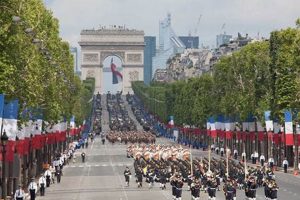
July 14th at the former royal residence represents a complex intersection of history and national identity. The date commemorates a pivotal event in the French Revolution, while the location stands as a symbol of the monarchy that was overthrown during that period. Observing this national holiday at this specific site underscores the transformations that have shaped modern France.
The significance lies in the juxtaposition of revolutionary ideals and the remnants of royal power. This creates a space for reflection on the nation’s journey from absolutism to a republic. Celebrations may include historical reenactments, public gatherings, and displays of national pride, emphasizing the values of liberty, equality, and fraternity. These events provide an opportunity to connect with the past and reaffirm commitment to the principles of the Revolution.
The following will examine in detail the nature of events typically held, the historical underpinnings of the celebration, and the overall cultural impact of commemorating this significant date at this iconic location.
Guidance for Visiting the Palace on July 14th
Planning a visit to the Palace during the national holiday requires careful consideration due to increased crowds and security measures. The following tips aim to facilitate a safe and enriching experience.
Tip 1: Secure Tickets in Advance: Due to the event’s popularity, pre-purchasing tickets online is essential. This measure avoids long queues and ensures entry to the palace grounds and any associated events.
Tip 2: Arrive Early: Expect significant congestion. Arriving well before the scheduled start of events allows ample time for security checks and finding a suitable viewing location.
Tip 3: Understand Security Protocols: Be aware of enhanced security measures, including bag checks and potential restrictions on certain items. Familiarize yourself with the palace’s guidelines prior to arrival.
Tip 4: Utilize Public Transportation: Parking near the palace is extremely limited. Public transportation options, such as the RER C train, are recommended to mitigate traffic and parking challenges.
Tip 5: Pack Appropriately: Wear comfortable shoes as extensive walking is unavoidable. Bring sunscreen, water, and any necessary medications.
Tip 6: Consult the Official Website: Official palace and tourism websites will offer the most up-to-date information regarding event schedules, closures, and any specific regulations in place for the holiday.
Tip 7: Respect the Historical Significance: Remember that July 14th commemorates a pivotal moment in French history. Be mindful and respectful of the site’s historical importance and the solemnity of the occasion.
Adhering to these guidelines will help ensure a smoother and more enjoyable experience while visiting the Palace during the national holiday. These preparations facilitate engagement with the cultural and historical significance of the location and date.
The next section will explore the historical events that are commemorated and their lasting impact on the nation.
1. Historical Juxtaposition
The presence of the French national holiday at the Palace creates a compelling historical juxtaposition. This intersection of location and date invites a deeper examination of France’s revolutionary history.
- Symbol of Absolutism vs. Revolution
The Palace historically served as the primary residence of French monarchs, embodying absolute power and privilege. Conversely, the date commemorates the storming of the Bastille, a symbol of royal authority and oppression. Commemorating the revolution at the Palace highlights the dramatic shift in power dynamics that occurred.
- Royal Opulence and Republican Values
The Palace’s extravagant architecture and decor represent the opulence enjoyed by the aristocracy under the ancien rgime. The French Revolution championed values of equality and fraternity, directly challenging this hierarchical social structure. Events at the Palace on this date, therefore, invite reflection on the contrast between pre-revolutionary excess and republican ideals.
- Memory and Reconciliation
The commemoration provides an opportunity to engage with a complex and often turbulent past. By acknowledging both the excesses of the monarchy and the violence of the Revolution, the nation attempts to reconcile with its history and forge a unified identity. The location itself becomes a site of memory, prompting both remembrance and reconciliation.
- Continuity and Change
While the revolution brought about significant changes, it did not erase the past. The continued existence of the Palace serves as a reminder of France’s historical roots. Celebrating the national holiday here acknowledges both the rupture of the revolution and the enduring legacy of French history. It underscores the ongoing negotiation between tradition and progress.
These multifaceted juxtapositions underscore the complex nature of commemorating a revolutionary event at a former symbol of royal power. The resulting dialogue fosters a deeper understanding of France’s historical trajectory and its evolving national identity.
2. Symbolic Commemoration

The act of observing France’s national holiday at the Palace transcends a mere historical recounting; it functions as a powerful symbolic commemoration. This convergence of site and date amplifies the meaning of the holiday, imbuing it with layers of historical and cultural significance that warrant detailed consideration.
- Reversal of Power Dynamics
The Palace, once the epicenter of royal authority, becomes a stage for celebrating the overthrow of that authority. This deliberate inversion of power underscores the revolutionary principles of liberty, equality, and fraternity. The presence of the public on the grounds signifies the shift from monarchical rule to popular sovereignty.
- National Identity Forging
The selection of this location for national observances reinforces a specific narrative of French identity, one that emphasizes the triumph of republican ideals over aristocratic privilege. The holiday serves to unite the nation under a shared understanding of its past and a commitment to its present values. The very act of celebrating at this location contributes to that shared understanding.
- Reinterpretation of Heritage
The grounds of the Palace, despite their association with the monarchy, are reinterpreted as a space accessible to all citizens. This reappropriation of royal heritage signifies a collective ownership of the nation’s history, both its triumphs and its failures. The holiday events transform the space into a site of public memory and national celebration.
- Performance of Republican Values
The celebrations themselves, often featuring parades, musical performances, and historical reenactments, visually represent the core tenets of the French Republic. These performances serve as a reminder of the values for which the revolution was fought and reinforce the nation’s commitment to those principles. They are not simply entertainment; they are a deliberate enactment of national identity.
Consequently, the events on July 14th at the Palace are not merely historical reenactments or patriotic displays; they are carefully curated symbolic acts. They serve to reinforce the values of the French Republic, commemorate the revolution, and forge a collective national identity. The setting itself amplifies these symbolic dimensions, rendering the event far more impactful than a similar celebration in a less historically charged location.
3. Public Celebrations

Public celebrations form a central component of observing France’s national holiday at the Palace. The date commemorates a pivotal event in French history, and the Palace, despite its royal past, becomes a focal point for national expression. These celebrations serve as a mechanism for collective remembrance and reaffirmation of republican ideals. For example, the military parade on the Champs-lyses, while primarily centered in Paris, has echoes in smaller celebrations across the country, including those held at or near the Palace, emphasizing national unity.
The significance of these public displays lies in their ability to connect citizens with their national heritage and with one another. Events often include historical reenactments, musical performances, and fireworks displays, all designed to evoke a sense of national pride and shared identity. The presence of these celebrations at the Palace, a former symbol of royal authority, underscores the triumph of republican values and the accessibility of national heritage to all citizens. The practical effect is a tangible manifestation of national unity and a visible expression of the ideals upon which the French Republic was founded.
In essence, the public celebrations that take place as part of the commemoration at the Palace are not merely festive occasions; they are carefully orchestrated expressions of national identity and shared historical memory. These events reinforce the values of the French Republic and serve as a visible reminder of the nation’s journey from monarchy to a republic, creating a link between the past, present, and future. The ongoing challenge lies in ensuring that these celebrations remain inclusive and reflective of the diverse population of France, while maintaining their historical integrity and national significance.
4. Political Reflection

The commemoration of France’s national holiday at the Palace invites a nuanced political reflection. The location, once a symbol of absolute monarchy, provides a backdrop for examining the evolution of French political thought and the enduring challenges of republicanism.
- Legacy of the Revolution
The holiday prompts examination of the Revolution’s impact on French political structures and values. Considerations include the extent to which revolutionary ideals have been realized and the ongoing debates surrounding liberty, equality, and fraternity. This involves assessing the Revolution’s successes and failures in shaping contemporary French society. This examination acknowledges both the aspirational goals of the Revolution and its complex, often violent, trajectory.
- Republican Ideals vs. Modern Challenges
The commemoration provides an opportunity to evaluate the relevance of republican ideals in the face of contemporary political challenges. Issues such as social inequality, immigration, and national identity are brought into sharper focus. The holiday serves as a reminder of the ongoing need to adapt and reaffirm republican values in a rapidly changing world. The juxtaposition of historical ideals and current realities encourages critical assessment of the nation’s political progress.
- National Identity and Inclusivity
Celebrations at the Palace raise questions about national identity and the inclusivity of French society. Reflection is prompted about who is considered “French” and how the nation can better integrate its diverse population. The holiday encourages dialogues about the balance between preserving national traditions and embracing multiculturalism. Discussions around these issues underscore the ongoing effort to define a shared national identity that is both historically grounded and inclusive.
- Role of the State
The commemoration occasions reflection on the role of the state in French society. Considerations involve the balance between individual liberty and government intervention, as well as the state’s responsibility to promote social welfare and economic equality. The holiday encourages dialogue about the appropriate scope of state power and its impact on citizens’ lives. This reflection extends to the relationship between the state and its citizens and the responsibilities of each.
In conclusion, observing France’s national holiday at the Palace stimulates multifaceted political reflection. It prompts an examination of the Revolution’s legacy, the relevance of republican ideals, the challenges of national identity, and the role of the state. The holiday serves as a valuable opportunity for citizens to engage in critical dialogues about the future of French society and its commitment to democratic values. The presence of these reflective opportunities underscores the importance of historical awareness in shaping contemporary political discourse.
5. Cultural Identity

The observance of France’s national holiday at the Palace is inextricably linked to the construction and reinforcement of French cultural identity. The choice of this specific date and location is not arbitrary; it deliberately evokes a complex tapestry of historical events, societal transformations, and national values that collectively define what it means to be French. The holiday functions as a potent symbolic act, reinforcing a particular narrative of national identity that emphasizes republican ideals and the overthrow of the monarchy.
The Palace, formerly a symbol of royal absolutism, now serves as a stage for celebrating the triumph of republican values. The celebrations themselves, with their emphasis on liberty, equality, and fraternity, reinforce these core tenets of French identity. For instance, public gatherings, historical reenactments, and displays of the French flag all contribute to a shared sense of national belonging. These events provide citizens with a tangible connection to their history and a reaffirmation of their national values. Moreover, the accessibility of the Palace grounds on this date, formerly the exclusive domain of the aristocracy, symbolizes the democratic ideals of the republic. This act of reappropriation reinforces the notion that the nation’s heritage belongs to all its citizens.
Understanding the relationship between cultural identity and national celebrations at the Palace is practically significant because it illuminates how nations construct and reinforce shared values and beliefs. It also reveals the potential for national symbols to be reinterpreted and repurposed over time. Recognizing the symbolic power of these events allows for a more nuanced appreciation of their role in shaping national identity. However, challenges remain in ensuring that these celebrations are inclusive and reflective of the diverse population of France. The narrative of national identity should acknowledge the contributions of all citizens and avoid perpetuating exclusionary or stereotypical representations. The ongoing effort to balance historical fidelity with contemporary inclusivity is essential to maintaining the relevance and legitimacy of these national commemorations.
Frequently Asked Questions
This section addresses common inquiries regarding events and considerations for those planning to visit during the national holiday.
Question 1: Is there a fee to enter the Palace grounds during the July 14th celebrations?
Admission policies vary. Some areas and events may be free and open to the public, while others may require a ticket. Official websites provide the most accurate information regarding admission fees and ticket availability.
Question 2: What security measures are in place for the July 14th events?
Enhanced security protocols are typically implemented, including bag checks, metal detectors, and increased police presence. Visitors should expect delays and are advised to avoid bringing unnecessary items. Prohibited items lists are usually published on the official website.
Question 3: Are there specific transportation recommendations for reaching the Palace on July 14th?
Public transportation, particularly the RER C train, is strongly recommended due to heavy traffic congestion and limited parking. Shuttle services may also be available from designated locations. Consult public transportation websites for schedules and potential service disruptions.
Question 4: What types of events can one expect to see during the July 14th commemoration?
Events may include historical reenactments, musical performances, fireworks displays, and public addresses. Specific schedules and event details are generally released closer to the date on official government and palace websites.
Question 5: Is it necessary to speak French to fully appreciate the July 14th celebrations at the Palace?
While some events may be conducted in French, the visual aspects of the celebrations, such as parades and fireworks, are universally accessible. Multilingual information may also be available at certain locations. Familiarity with the history surrounding the date will enhance the experience.
Question 6: Are there any restrictions on photography or filming during the July 14th events?
Flash photography may be restricted in certain areas, and commercial filming requires prior authorization. Adherence to posted guidelines and instructions from event staff is expected. Respect for the performers and other attendees is paramount.
In summary, planning and preparation are key to a successful visit. Checking official resources, understanding security procedures, and utilizing public transportation will enhance the experience of commemorating this national holiday at this historical site.
The following section will offer alternative locations to celebrate France’s national holiday, should a visit to the Palace not be feasible.
Conclusion
This exploration has underscored the multifaceted significance of “versailles on bastille day.” The juxtaposition of revolutionary ideals and the site of royal power creates a unique setting for national commemoration. The historical, symbolic, political, and cultural dimensions of this event contribute to a complex and nuanced understanding of French identity.
Further investigation into the evolution of these celebrations and their impact on shaping national discourse is warranted. Continued engagement with this historical and cultural intersection is crucial for comprehending the ongoing negotiation between France’s past and its future. The enduring resonance of this date and location provides a valuable lens through which to examine the ever-evolving nature of national identity.


![Buy Doom Days Bastille Vinyl: Collector's Edition [Rare] | Hubbastille: Explore the Fusion of Culture, Music & Creativity](https://hubbastille.com/wp-content/uploads/2026/05/th-83-300x200.jpg "Buy Doom Days Bastille Vinyl: Collector's Edition [Rare] Hubbastille: Explore the Fusion of Culture, Music & Creativity")