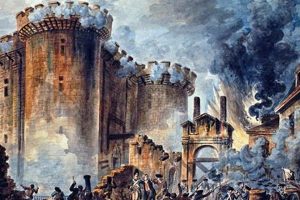
The capture of the Bastille, a medieval fortress and prison in Paris, by revolutionary insurgents on July 14, 1789, represents a pivotal moment in the French Revolution. The event, though involving the release of only a handful of prisoners, symbolized the overthrow of royal authority and the end of arbitrary imprisonment under the French monarchy.
Its importance lies in its symbolic destruction of the old order. The Bastille had become a potent symbol of the Bourbon monarchy’s perceived tyranny. The act of storming it demonstrated the people’s resolve to challenge royal power and their willingness to use force to achieve their goals. This uprising fueled the revolutionary fervor, emboldened revolutionaries throughout France, and accelerated the collapse of the existing political structure. The event directly contributed to the declaration of the Rights of Man and of the Citizen, a foundational document of the revolution, and spurred widespread reforms aimed at establishing a more democratic and equitable society.
The assault on the Bastille therefore serves as a cornerstone event when examining the complexities and consequences of popular revolution. Its legacy continues to resonate as a reminder of the power of collective action in the pursuit of liberty and social justice.
Understanding the Ramifications of the Fall of the Bastille
Analyzing the implications of the capture of the Bastille requires a thorough understanding of the socio-political landscape of pre-revolutionary France. Consider these points for a deeper insight:
Tip 1: Explore the Socio-Economic Context: Examine the widespread economic hardship and social inequalities that fueled popular discontent. High taxes, food shortages, and a rigid class system created fertile ground for rebellion.
Tip 2: Analyze the Symbolism of the Bastille: The Bastille was not merely a prison; it represented royal authority and arbitrary justice. Its capture was a direct assault on the king’s power and a symbolic victory for the people.
Tip 3: Understand the Role of Revolutionary Propaganda: Pamphlets, newspapers, and speeches played a crucial role in mobilizing public opinion against the monarchy. Analyze how these forms of communication shaped perceptions of the Bastille and its significance.
Tip 4: Assess the Short-Term Consequences: The event led to immediate changes, including the formation of the National Guard and the dismantling of the Bastille. Evaluate how these developments impacted the balance of power in Paris.
Tip 5: Evaluate the Long-Term Impact on the French Revolution: The event served as a catalyst for further revolutionary actions, including the abolition of feudalism and the Declaration of the Rights of Man and of the Citizen. Understand its place within the broader trajectory of the revolution.
Tip 6: Research the Mythologization of the Event: Over time, the fall of the Bastille has become a potent symbol of freedom and resistance. Investigate how its narrative has been shaped and reinterpreted by historians and popular culture.
These considerations provide a framework for understanding the multidimensional importance of the storming of the Bastille, from its immediate consequences to its enduring legacy as a symbol of revolutionary change.
By incorporating these tips, a more comprehensive understanding of this critical historical event can be achieved.

The Bastille, prior to its storming, functioned as a potent emblem of royal authority and the arbitrary power of the French monarchy. Understanding its symbolic weight is crucial to fully grasp the historical importance of its capture by revolutionary forces. Its role as a symbol directly informs an analysis of why its fall was so significant.
- Bastille as a State Prison:
The Bastille served primarily as a prison, often housing individuals detained on the lettre de cachet, orders signed by the king that allowed for imprisonment without trial or due process. This practice epitomized the unchecked power of the monarchy and the lack of legal recourse available to ordinary citizens. The imprisonment of individuals for political dissent or even personal vendettas solidified the Bastille’s image as a tool of oppression.
- Fortress Architecture and Impenetrability:
The imposing architecture of the Bastille, with its high walls, towers, and fortified gates, visually reinforced its image as an unassailable stronghold of royal power. Its physical presence dominated the Parisian landscape, serving as a constant reminder of the monarchy’s strength and the futility of resistance. The perceived impregnability of the fortress added to its symbolic weight as a representation of the enduring and unyielding nature of royal authority.
- Royal Arsenal and Military Garrison:
Beyond its function as a prison, the Bastille also served as a royal arsenal and was defended by a military garrison. This dual function highlighted the monarchy’s control over both the legal and military instruments of power. The presence of weapons and soldiers within the Bastille underscored the king’s ability to enforce his will through force and to suppress any potential uprising. The garrison was small, but the symbolism of a standing royal army was vital.
- Symbolic Target for Revolutionary Discontent:
Because of its multifaceted representation of royal power, the Bastille became a natural target for revolutionary discontent. Its capture was not merely about freeing prisoners or seizing weapons; it was a direct challenge to the monarchy’s legitimacy and a symbolic overthrow of its authority. The act of storming the Bastille demonstrated the people’s willingness to confront royal power directly and to dismantle the symbols of oppression that had long defined their lives. The act was about defiance, not just liberation.
These facets illustrate the degree to which the Bastille represented the oppressive reach of the Bourbon monarchy. By understanding the structure as a symbol of royal authority, the significance of its storming becomes abundantly clear. The capture of the Bastille was a potent statement that the people no longer accepted the unchecked power of the king and were willing to take radical action to achieve their goals.
2. Triggered wider revolution

The seizure of the Bastille acted as a critical catalyst, igniting the more extensive and transformative phases of the French Revolution. This connection reveals a direct causal relationship: the event’s repercussions transcended its immediate impact, propelling France into a period of profound social, political, and economic upheaval. It signified more than the release of prisoners; it represented a fundamental challenge to the existing power structure, encouraging broader resistance and accelerating the revolution’s trajectory. For example, the storming of the Bastille preceded the Great Fear, a period of rural panic and revolt that further destabilized the Ancien Rgime. The success in Paris emboldened peasants and provincial populations to rise against their feudal lords, contributing to the dismantling of feudalism. Understanding this triggering effect is paramount to comprehending the storming’s long-term historical significance.
The practical manifestation of this triggering effect is evident in the subsequent actions taken by revolutionary groups. The success at the Bastille provided momentum for the formation of the National Guard, a citizen militia intended to maintain order and defend the revolution against potential royalist backlash. Furthermore, it galvanized efforts to draft the Declaration of the Rights of Man and of the Citizen, a foundational document that enshrined principles of liberty, equality, and fraternity. These developments directly stemmed from the confidence and empowerment gained by the revolutionaries at the Bastille. In essence, the event served as a watershed moment, transforming localized unrest into a widespread movement aimed at systemic change.
In summary, the siege of the Bastille must be viewed as an instigating force that propelled the French Revolution beyond a localized Parisian event. Its success emboldened revolutionary elements, accelerated the collapse of the old order, and paved the way for radical reforms. Recognizing this connection is crucial for a complete appreciation of the event’s historical importance and its role in shaping the course of modern European history. Challenges to fully understanding this trigger lie in disentangling its impact from other concurrent factors, but its significance as a primary catalyst remains undeniable.
3. Empowerment of the people
The capture of the Bastille directly contributed to a palpable shift in power dynamics, resulting in a significant empowerment of the common citizenry. This empowerment, manifested in various forms, profoundly impacted the trajectory of the French Revolution and remains a crucial element in understanding its historical significance.
- Direct Action and Overthrow of Symbol of Authority
The act of storming the Bastille represented a tangible demonstration of popular sovereignty. Citizens, previously marginalized and subject to the arbitrary rule of the monarchy, took direct action to dismantle a symbol of their oppression. This successful assault instilled a sense of agency and demonstrated that collective action could effectively challenge established power structures. The previously unassailable fortress became vulnerable, proving the authority was not absolute.
- Rise of Citizen Militias and Self-Governance
Following the Bastille’s fall, citizen militias, such as the National Guard, emerged. These armed groups, composed of ordinary Parisians, assumed responsibility for maintaining order and defending the revolution. This development signified a departure from the traditional model of centralized control and fostered a sense of self-governance. People, for the first time, were responsible for their own safety and security, a clear example of empowerment. This transition marked an early stage of the establishment of a government led by people.
- Influence on Revolutionary Discourse and Political Participation
The empowerment stemming from the Bastille’s capture fueled greater political participation among the common populace. Revolutionary clubs and societies proliferated, providing forums for debate and the articulation of grievances. Ordinary citizens became actively involved in shaping the course of the revolution, contributing to the drafting of the Declaration of the Rights of Man and of the Citizen and demanding further reforms. This new level of influence was only possible because of a sense of confidence and power to change the society.
- Inspiration for Subsequent Revolutionary Movements
The events in Paris, and particularly the capture of the Bastille, resonated far beyond France, inspiring revolutionary movements across Europe and the world. The example of ordinary citizens successfully challenging and overthrowing a symbol of royal authority served as a powerful motivator for those seeking to dismantle oppressive regimes and establish more democratic societies. This ripple effect demonstrates the profound and lasting impact of popular empowerment. The inspiration to later groups across the world cannot be overstated.
These various aspects of empowerment, directly linked to the capture of the Bastille, illuminate its profound significance. The event not only symbolized the collapse of royal authority but also marked the beginning of a new era characterized by greater citizen participation, self-governance, and a widespread belief in the power of collective action to effect meaningful change. The impact is seen to this day as a cornerstone in global revolution movements.
4. Undermined monarchical control
The storming of the Bastille represented a direct and undeniable challenge to the legitimacy and power of the French monarchy. It served as a critical inflection point, initiating a sequence of events that progressively eroded the foundations of royal authority and paved the way for a more representative form of government. The erosion of monarchical control is thus inextricably linked to understanding the overall meaning of the event.
- Symbolic Defiance and Loss of Prestige
The Bastille, as a tangible symbol of royal power and arbitrary imprisonment, represented the very essence of monarchical control. Its capture by revolutionary forces demonstrated the king’s inability to protect his own symbols of authority, leading to a significant loss of prestige and public confidence. The symbolic importance outweighed its strategic value.
- Erosion of Military Authority and Loyalty
The storming exposed the limitations of the monarchy’s military control. The garrison defending the Bastille was relatively small, but its failure to repel the attack revealed a lack of effective command and control. More significantly, it demonstrated the potential for soldiers, drawn from the common populace, to sympathize with the revolutionary cause, further weakening the monarchy’s ability to enforce its will. The lack of loyalty amongst troops was a glaring issue.
- Empowerment of Competing Political Forces
The fall of the Bastille empowered nascent political factions, such as the National Assembly, which sought to limit the king’s power and establish a constitutional monarchy. The event provided these factions with a surge of popular support and legitimacy, enabling them to challenge the king’s authority more effectively and push for reforms that curtailed royal prerogatives. The balance of power shifted considerably.
- Precedent for Further Revolutionary Action
The successful storming served as a precedent for subsequent revolutionary actions, emboldening citizens to further challenge royal authority and demand greater political participation. It signaled that the monarchy was not invulnerable and that organized popular resistance could achieve tangible results. This established pattern of resistance fueled a cycle of escalating demands and ultimately led to the abolition of the monarchy altogether. This pattern of escalation was set into motion because of the storming.
In summary, the capture of the Bastille directly undermined monarchical control by eroding its symbolic authority, exposing its military weaknesses, empowering competing political forces, and setting a precedent for further revolutionary action. These interconnected factors demonstrate the event’s pivotal role in dismantling the Ancien Rgime and ushering in a new era of political and social change in France. The action had lasting political changes that were pivotal to a more representative government.
5. Catalyst for Reforms
The assault on the Bastille acted as a crucial catalyst, accelerating the implementation of wide-ranging reforms that fundamentally altered the French social and political landscape. The event’s significance extends beyond its symbolic value, directly influencing the pace and scope of subsequent revolutionary changes. The impetus for these reforms stemmed from the palpable shift in power dynamics following the storming.
- Abolition of Feudalism
The storming of the Bastille fueled popular uprisings in the countryside, leading to the “Great Fear” and widespread attacks on aristocratic estates. In response, the National Assembly, emboldened by the events in Paris, abolished feudal privileges and seigneurial rights on August 4, 1789. This radical measure eliminated centuries-old inequalities and redistributed power and wealth more equitably. The action removed burdens from the peasantry that contributed to deep widespread systemic changes.
- Declaration of the Rights of Man and of the Citizen
Inspired by Enlightenment ideals and the spirit of revolutionary fervor, the National Assembly adopted the Declaration of the Rights of Man and of the Citizen on August 26, 1789. This foundational document enshrined principles of liberty, equality, and fraternity, establishing fundamental rights and freedoms for all citizens. The Declaration, a direct consequence of the revolutionary climate ignited by the assault, provided a framework for a more just and democratic society. This provided a guide for the revolution to ensure equal rights for all its citizens.
- Reforms of the Church
In the wake of the Bastille’s fall, the revolutionary government implemented reforms targeting the Catholic Church, a powerful institution closely aligned with the monarchy. Church lands were nationalized, and the Civil Constitution of the Clergy, adopted in 1790, reorganized the Church along national lines, requiring clergy to swear an oath of allegiance to the state. These reforms aimed to diminish the Church’s power and influence and to bring it under state control. The power of the church diminished quickly after the storming in effort to secularize the government.
- Establishment of a Constitutional Monarchy
The storming of the Bastille accelerated the transition from an absolute monarchy to a constitutional monarchy. The king, weakened and discredited, was forced to accept limitations on his power and to share authority with the National Assembly. The Constitution of 1791 formally established a constitutional monarchy, outlining the respective powers of the king and the legislative body. This restructuring, while not fully satisfying radical revolutionaries, represented a significant step towards a more representative form of government. Checks and balances were more easily achieved as the assembly controlled the power of the king.
These reforms, enacted in the aftermath of the Bastille’s capture, demonstrate the event’s profound impact on the trajectory of the French Revolution. The storming not only symbolized the collapse of royal authority but also served as a catalyst for transformative changes that reshaped French society, politics, and culture. Understanding these reformative consequences is essential for a complete appreciation of the event’s enduring historical significance. These points provide a glimpse into the transformative events that changed the dynamics of the nation.
Frequently Asked Questions
This section addresses common inquiries regarding the historical importance of the assault on the Bastille, aiming to provide clear and concise answers based on factual information.
Question 1: What exactly was the Bastille?
The Bastille was a medieval fortress in Paris that, by the late 18th century, primarily functioned as a state prison. It also served as a royal armory. It had become a symbol of the Bourbon monarchy’s arbitrary power and unjust imprisonment practices.
Question 2: Why did the people storm the Bastille?
The storming was motivated by a combination of factors, including the desire to acquire weapons and gunpowder believed to be stored within, to release prisoners perceived as unjustly incarcerated, and, crucially, to challenge the King’s authority. The populace wanted to challenge the monarchy.
Question 3: How many prisoners were actually freed during the storming?
Contrary to popular imagination, only seven prisoners were freed. The importance resides not in the number of prisoners, but in the symbolic act of defying royal authority and dismantling a symbol of oppression.
Question 4: In what way did it trigger the French Revolution?
The assault served as a catalyst for widespread revolutionary fervor. It demonstrated the potential for popular uprising, emboldening revolutionaries throughout France and accelerating the collapse of the Ancien Rgime.
Question 5: How did the event weaken monarchical control?
The storming undermined the monarchy’s prestige, exposed its military vulnerabilities, and empowered competing political forces. The act was a direct challenge to the king’s authority and revealed the limits of his power.
Question 6: What reforms directly resulted from the capture?
The storming directly contributed to the abolition of feudalism, the drafting of the Declaration of the Rights of Man and of the Citizen, and the implementation of reforms targeting the Catholic Church. All of these came as a direct consequence of this storming.
In essence, the events at the Bastille were critical for the revolution.
Considerations of these points will enable a deeper comprehension of this critical episode.
Explain the Significance of the Storming of the Bastille
The preceding analysis has demonstrated that the storming of the Bastille transcends its immediate historical context to represent a pivotal turning point in the French Revolution and, arguably, modern European history. It was not merely a prison break or a siege but a symbolic act of defiance against royal tyranny that ignited revolutionary fervor, empowered the common citizenry, undermined monarchical control, and acted as a catalyst for transformative reforms. These multifaceted consequences underscore the event’s enduring significance as a watershed moment.
Understanding its lasting impact requires a continued examination of its influence on subsequent social, political, and ideological developments. It stands as a testament to the power of collective action in the pursuit of liberty and social justice, and its legacy continues to resonate in contemporary struggles for democracy and human rights worldwide. The assault serves as a reminder of the fragility of power and the enduring potential for popular resistance to reshape the course of history.



![Bastille Storm's Impact: What Was the Outcome? [Explained] | Hubbastille: Explore the Fusion of Culture, Music & Creativity](https://hubbastille.com/wp-content/uploads/2026/01/th-33-300x200.jpg "Bastille Storm's Impact: What Was the Outcome? [Explained] Hubbastille: Explore the Fusion of Culture, Music & Creativity")