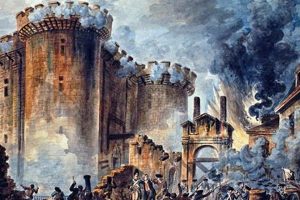
The event refers to a pivotal moment in the French Revolution. It involved an assault on a medieval fortress and prison in Paris on July 14, 1789. This structure, though holding only a handful of prisoners at the time, symbolized royal authority and oppression to the common people.
The action holds significant importance as a catalyst for the French Revolution. It demonstrated the people’s willingness to challenge the monarchy and ultimately contributed to the overthrow of the French aristocracy. The event has become a symbol of liberty and the fight against tyranny, influencing subsequent revolutionary movements worldwide.
The following sections will delve into the specific causes leading up to this dramatic occurrence, the immediate aftermath within the city of Paris, and the long-term effects on the trajectory of France and Europe as a whole.
Examining the Significance of the Bastille Assault
Understanding the nuances of the action on July 14, 1789, necessitates considering several key aspects of the era. Its impact transcended a mere prison break; it resonated deeply with the French populace and continues to inform perspectives on revolution and social change.
Tip 1: Consider the Symbolic Value: The fortress represented royal authority and the perceived injustices of the Bourbon monarchy. Its capture symbolized the weakening of this authority and instilled hope for change within the oppressed populace.
Tip 2: Evaluate the Socio-Economic Context: France in 1789 was facing severe economic hardship, with widespread famine and inequality. This discontent fueled the revolutionary fervor, and the actions taken gave tangible expression to the collective frustration.
Tip 3: Analyze the Role of Public Perception: The event, although relatively small in terms of casualties and number of prisoners freed, was immediately amplified by the Parisian press and spread rapidly throughout the country. This shaped public opinion and solidified the revolutionary cause.
Tip 4: Recognize the Influence of Enlightenment Ideals: The revolutionary movement was heavily influenced by Enlightenment thinkers who advocated for individual rights, popular sovereignty, and limitations on government power. The assault was seen as a step towards realizing these ideals.
Tip 5: Understand the Military Implications: While not a major military victory, the capture provided revolutionaries with weapons and ammunition, boosting their confidence and enabling them to more effectively challenge royal forces.
Tip 6: Assess the Impact on Political Radicalization: The assault contributed to the rapid radicalization of the revolution. It emboldened more extreme factions and weakened the position of those who favored moderate reform.
By exploring these facets, a more comprehensive understanding of the historical action emerges, highlighting its complex causes and far-reaching consequences. It serves as a reminder of the power of collective action and the potential for social upheaval in the face of injustice.
In conclusion, the analysis of the event paves the way for a deeper exploration of the subsequent phases of the French Revolution and its lasting impact on modern political thought.
1. Symbol of Royal Authority

The fortress served as a potent representation of the French monarchy’s authority. Its imposing structure and function as a state prison embodied the arbitrary power and control exerted by the ruling class. The focus of popular anger on this location underscores its significance in the lead-up to the revolution.
- Architecture as a Statement of Power
The Bastille’s formidable architecture, characterized by high walls, towers, and a moat, served as a constant visual reminder of the monarchy’s strength and invincibility. This physical manifestation of power reinforced the perceived unassailability of the ruling regime in the minds of the Parisian populace.
- Imprisonment of Political Dissidents
The prison housed individuals who had challenged the monarchy’s authority, including writers, philosophers, and political activists. Their confinement within its walls demonstrated the monarchy’s intolerance of dissent and its willingness to suppress opposition through imprisonment.
- Lettres de Cachet and Arbitrary Justice
The use of lettres de cachet, royal orders that allowed for imprisonment without trial, exemplified the arbitrary nature of royal justice. The Bastille became synonymous with this system, representing the lack of due process and the potential for abuse of power by the monarchy.
- Historical Significance of the Location
The site itself had been associated with royal power since the Middle Ages, further solidifying its symbolic importance. Over time, it had evolved from a defensive fortress into a symbol of the monarchy’s control over Paris and its inhabitants.
The choice of the Bastille as a target was not arbitrary; it was a direct challenge to the very essence of royal authority. The successful assault undermined the monarchy’s perceived power and signaled a decisive shift in the balance of power towards the revolutionary forces. It highlighted the people’s rejection of absolute rule and their desire for a more just and equitable society, which the Storming of Bastille represent.
2. Popular Uprising

The assault was fundamentally an act of popular uprising. It was not orchestrated by a centralized authority but rather emerged from widespread discontent among the Parisian populace. Several factors contributed to this unrest, including economic hardship, perceived injustices of the feudal system, and a desire for political representation. The event provides a concrete example of how societal grievances can manifest in direct action against symbols of power.
The composition of the attacking crowd reflected the diverse social strata of Paris. Artisans, merchants, and laborers participated, united by a common resentment towards the monarchy. The absence of a formal military structure within the attacking force underscores the spontaneous and grassroots nature of the event. For instance, the Gardes Franaises, a regiment of the French army largely sympathetic to the revolutionary cause, provided crucial support, but the initial impetus came from civilian Parisians.
The direct impact of the popular uprising extended beyond the immediate seizure of the fortress. It signaled a shift in power dynamics, demonstrating that the populace was willing to challenge royal authority. This emboldened revolutionary factions and contributed to the acceleration of the revolution. The event therefore serves as a crucial example of how popular uprising can act as a catalyst for broader societal transformation. The act of populace directly translates the importance of the Bastille event.
3. Release of Prisoners

The aspect of prisoner release, while seemingly a central objective of the assault, represents a more complex and nuanced facet of the event. Its significance extends beyond the mere liberation of individuals held within the prison walls, offering insight into the motivations and consequences of the revolutionary action.
- Limited Number of Inmates
At the time of the assault, the Bastille held a relatively small number of prisonerstypically cited as seven. These individuals were incarcerated for various reasons, ranging from forgery to political offenses. This fact underscores that the primary motivation was not solely focused on freeing a large contingent of unjustly imprisoned citizens, but rather on targeting a symbol of royal power.
- Symbolic Value of Liberation
Despite the limited number of inmates, the act of releasing them carried significant symbolic weight. It represented a challenge to the monarchy’s power to arbitrarily detain individuals and a rejection of the system of lettres de cachet, which allowed for imprisonment without due process. The released prisoners became symbols of resistance against tyranny, further fueling the revolutionary cause.
- Impact on Public Perception
The dissemination of stories about the released prisoners, regardless of the specifics of their individual cases, contributed to the narrative of royal oppression and fueled public support for the revolution. These narratives, often embellished, played a role in shaping public perception of the event and its significance.
- Subsequent Treatment of the Released
The released prisoners were hailed as heroes and paraded through the streets of Paris, further solidifying their symbolic importance. This public celebration highlighted the revolutionary ideals of liberty and justice and served as a powerful message to both the monarchy and the rest of the French population.
In conclusion, the detail of prisoner release, while involving a small number of individuals, played a vital role in amplifying the importance. It served as a potent symbol of resistance against royal authority and contributed to the growing revolutionary fervor. The act of liberation, therefore, must be understood within the broader context of challenging royal power and promoting the ideals of liberty and justice.
4. Seizure of Weapons

The acquisition of armaments during the assault was a critical component. It not only provided the revolutionaries with the means to defend themselves but also symbolized a direct challenge to the military dominance of the monarchy. The act of seizing weapons reflects the escalating conflict and the revolutionaries’ determination to achieve their goals through force if necessary.
- Source of Arms and Ammunition
The primary objective in attacking was to secure gunpowder and firearms. The arsenal within the fortress held a significant stockpile, making it a strategic target for the Parisian insurgents. The seizure provided them with essential resources to continue their fight against royal forces.
- Empowering the Revolutionaries
The newly acquired weaponry significantly bolstered the revolutionaries’ military capabilities. Armed citizens presented a more credible threat to the monarchy, potentially attracting more supporters and emboldening further acts of resistance. It also provided the means to protect themselves against royal troops dispatched to quell the unrest.
- Symbolic Defiance of Royal Authority
Taking control of the weaponry represented more than just a military gain. It symbolized the transfer of power from the monarchy to the people. This act of defiance resonated throughout Paris and the rest of France, inspiring further uprisings and solidifying the revolutionary cause. The arms provided material and symbolic power.
- Escalation of the Conflict
The seizure inevitably led to a more violent and prolonged conflict. The monarchy perceived the armed citizenry as a direct threat to its authority, prompting a forceful response. This escalation marked a turning point in the revolution, pushing both sides towards open warfare and making compromise increasingly unlikely. From this point onward, the potential for negotiated settlement diminished.
In summary, the seizure of weapons represents a critical turning point. It transformed a demonstration of popular discontent into an armed rebellion. The acquisition of arms provided the revolutionaries with the means to challenge royal authority, symbolizing their determination to achieve fundamental societal change. The event underscores the escalating conflict and the irreversible shift in power dynamics that characterized the early stages of the French Revolution, all stemming back to the main focal point.
5. Revolutionary Catalyst
The assault on the fortress served as a significant impetus for the French Revolution. The action, while not strategically decisive in a military sense, ignited revolutionary fervor across France. Prior to the event, discontent simmered due to social inequalities, economic hardship, and political disenfranchisement. The act provided a focal point for these grievances, transforming simmering resentment into overt resistance.
The event’s impact lies in its symbolic and practical consequences. It demonstrated the monarchy’s vulnerability and inspired common citizens to take direct action against established authority. News of the event spread rapidly through pamphlets and word-of-mouth, mobilizing populations in other parts of France to challenge local authorities and aristocratic power. The seizure of weapons provided a tangible means of resistance, while the release of prisoners, however few, became a symbol of liberation from tyranny. Furthermore, the involvement of the Gardes Franaises, who sided with the revolutionaries, highlighted the fracturing of royal authority and emboldened others to defect.
In conclusion, it was not merely an isolated event but a watershed moment that accelerated the French Revolution. It galvanized popular support, weakened the monarchy’s legitimacy, and provided a template for revolutionary action. The practical significance of understanding this connection lies in recognizing how a single event can act as a catalyst for broader social and political transformation, a pattern observed in subsequent revolutions throughout history. By studying the details, a valuable opportunity is provided for assessing the complexities inherent in revolutionary movements and to recognize its long lasting effects.
6. July 14, 1789

That date marks the day a pivotal event unfolded in Paris. The occasion directly refers to the moment when Parisian crowds assaulted the Bastille. This connection is not merely temporal; the date is the event. The phrase references that specific historical occurrence. Considering the relationship as cause and effect is inaccurate because the date and the event are synonymous. It is more accurate to consider the date as an identifier for that episode in history. Without knowledge of July 14, 1789, discussions of the causes, consequences, and historical significance of that event lose their context and fail to pinpoint the historical moment accurately.
Understanding that the action occurred on July 14, 1789, allows for practical application in historical research and analysis. For instance, examining primary sources like diaries or official reports from that date provides direct insight into the event and the societal conditions that enabled the moment. Secondary sources, such as scholarly articles and books on the French Revolution, consistently reference the date to situate the action within the broader historical timeline. Accurate dating also facilitates the correlation of the action with related events, like the Tennis Court Oath or the Declaration of the Rights of Man and of the Citizen, to establish a chronological understanding of the unfolding revolution.
In summary, July 14, 1789, is not just a date but the precise identifier for a crucial occurrence in the French Revolution. It is inextricably linked to the revolutionary action itself. A firm grasp of this connection is vital for historical investigation, providing a temporal anchor for understanding its causes, effects, and enduring historical importance.
7. Weakened Monarchy

The assault directly contributed to the erosion of the French monarchy’s authority. The event exposed the vulnerability of royal power and demonstrated the capacity of the populace to challenge the established order. Prior to July 14, 1789, the Bourbon monarchy, embodied by King Louis XVI, projected an image of unassailable dominance. However, the successful siege revealed the fragility of this facade. For instance, the inability of the royal garrison to effectively defend the fortress exposed the limitations of royal military control. The defection of elements of the Gardes Franaises further undermined confidence in the monarchy’s ability to maintain order and enforce its rule.
The event’s symbolic weight was instrumental in eroding the monarchy’s legitimacy. The fact that common citizens could successfully storm a state prison and seize weapons challenged the long-held belief in the king’s divine right to rule. This encouraged more widespread dissent and provided impetus for revolutionary movements across France. Furthermore, the King’s initial hesitancy in responding decisively to the attack conveyed weakness and indecision, undermining his leadership in the eyes of both the populace and the aristocracy. The subsequent concessions made by Louis XVI, such as accepting the tricolor cockade, were perceived as signs of weakness and further eroded royal authority.
The weakening of the monarchy was not merely a consequence, but a necessary component of the revolutionary process. It paved the way for the establishment of a constitutional monarchy and, ultimately, the overthrow of the monarchy altogether. The attack stands as a significant example of how popular uprising can directly undermine even the most entrenched systems of power. Recognizing the link between the event and the monarchy’s decline provides a better understanding of the dynamics of revolution and the conditions under which established authorities lose their legitimacy. This understanding carries practical significance in the analysis of other historical and contemporary political upheavals, where the erosion of central authority often plays a crucial role in enabling transformative change.
Frequently Asked Questions
The following questions address common inquiries and misconceptions about the historical event. The aim is to provide clarity and context regarding its significance within the French Revolution.
Question 1: Was the liberation of prisoners the primary objective?
No. While the release of prisoners did occur, it was not the main motivation. The Bastille held relatively few inmates at the time. The principal aim was to acquire gunpowder and weaponry stored within the fortress and to challenge the symbolism of royal authority that the structure represented.
Question 2: Was it a highly organized military operation?
Not in the traditional sense. The action was largely a spontaneous uprising of Parisian citizens, lacking formal military command or planning. While some members of the Gardes Franaises participated, the initial impetus came from the common people.
Question 3: Did it immediately lead to the overthrow of the monarchy?
No. While the event significantly weakened royal authority and sparked revolutionary fervor, the overthrow of the monarchy was a process that unfolded over several years. The action marked a turning point, but it was followed by a period of political instability and upheaval before the monarchy was ultimately abolished.
Question 4: Was the violence excessive or disproportionate?
The violence, while significant, should be understood within the context of the heightened tensions and revolutionary atmosphere. While casualties occurred on both sides, the scale of the violence was not disproportionate to the symbolic importance of the target and the broader political context.
Question 5: Is its importance primarily symbolic rather than strategic?
Yes. Its primary importance lies in its symbolic representation of popular uprising against royal authority. While the acquisition of weapons was a tangible benefit, the event’s impact on public opinion and the broader revolutionary movement far outweighed any strategic military advantage.
Question 6: Did it occur in a vacuum, or were there preceding factors that contributed to it?
The assault occurred as a culmination of several pre-existing factors, including economic hardship, social inequality, and political disenfranchisement. Enlightenment ideals and growing discontent with the monarchy created a volatile environment that ultimately led to the revolutionary action.
In summary, the importance of understanding the event is that it provides clarity and context regarding its significance within the French Revolution and helps dispel common misconceptions about this revolutionary act.
The following sections will explore its representations in art and popular culture.
Conclusion
The preceding exploration has dissected the components of the historical action. Analysis has revealed its role as a catalyst within the broader narrative of the French Revolution. Emphasis has been given to the symbolic import of the event, its spontaneous genesis as a popular uprising, its significance in procuring armaments, the release of prisoners, its definitive placement on July 14, 1789, and finally, its integral contribution to the weakening of the French monarchy. Each of these factors underscores the critical nature of the event in understanding the subsequent course of French and European history.
Further inquiry into the sociopolitical contexts of the era is encouraged. Such investigations promise a refined comprehension of not only the historical action, but also of the underlying dynamics inherent to revolutionary movements across different times and geographic regions. Continued academic engagement serves to enrich comprehension of the forces that shape sociopolitical change, and “what was storming of bastille” will remain an important facet of any exploration.

![Bastille Storm's Impact: What Was the Outcome? [Explained] | Hubbastille: Explore the Fusion of Culture, Music & Creativity](https://hubbastille.com/wp-content/uploads/2026/01/th-33-300x200.jpg "Bastille Storm's Impact: What Was the Outcome? [Explained] Hubbastille: Explore the Fusion of Culture, Music & Creativity")