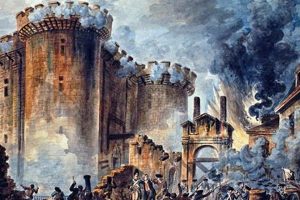
The event at the Bastille, a medieval fortress and prison in Paris, marked a significant shift in the course of the French Revolution. It signaled a dramatic escalation of popular discontent with the monarchy and the existing social order. The Bastille, though holding relatively few prisoners at the time, symbolized royal authority and oppression to the common people. Its capture represented a tangible victory for the revolutionaries, demonstrating the vulnerability of the King’s power.
The assault on the Bastille had profound consequences. It emboldened the National Assembly, providing them with the momentum and public support needed to challenge royal authority more directly. The event also triggered a wave of similar uprisings across France, contributing to the widespread breakdown of feudal structures and the redistribution of power. The act underscored the growing power of the people to effect change and inspired revolutionary movements throughout Europe. Its reverberations led to the decline of the old regime and a new era of social and political reform.
The capture of the Bastille became a potent symbol of the revolution’s ideals, particularly liberty and popular sovereignty. It fueled radical sentiment and accelerated the process of dismantling the existing political system. The repercussions included greater participation of citizens in governance, new political organizations, and ultimately, the shift towards a republic.
Understanding the Significance
Analyzing the episode at the Bastille requires a nuanced approach to fully comprehend its importance within the French Revolution.
Tip 1: Understand the Symbolism: Recognize that the Bastille represented more than just a prison; it was a symbol of royal authority and oppression. Its fall signified a blow against the old regime and a victory for the revolutionaries.
Tip 2: Assess the Immediate Impact: Consider the immediate consequences of the event. How did it affect the National Assembly? What was its influence on public opinion and the subsequent course of the revolution?
Tip 3: Evaluate the Ripple Effect: Analyze the secondary effects of the capture of the Bastille. Did it inspire similar uprisings in other parts of France? Did it influence political discourse or galvanize revolutionary fervor?
Tip 4: Research the Socio-Political Context: Examine the existing social and political conditions that led to the event. What grievances did the population have against the monarchy and the aristocracy? How did these factors contribute to the storming?
Tip 5: Analyze the Long-Term Consequences: Consider the long-term implications for France and Europe. How did the event impact the development of democracy, the rise of nationalism, or the decline of feudalism?
Tip 6: Consider Multiple Perspectives: Understand that the capture was viewed differently by various groups within society. Explore the perspectives of the revolutionaries, the monarchy, the aristocracy, and the common people.
Tip 7: Use Primary and Secondary Sources: Consult primary sources like contemporary accounts and documents, as well as secondary sources from historians and scholars, to gain a well-rounded understanding.
By considering these factors, a more thorough evaluation of the importance can be achieved.
These analytical strategies will equip one to appreciate this historical event’s weight in the French Revolution and subsequent history.
1. Symbolic Assault on Authority

The symbolic assault on authority enacted during the storming of the Bastille is inextricably linked to its status as a major juncture in the French Revolution. The Bastille, a medieval fortress used as a state prison, represented the arbitrary power of the monarchy and the oppressive nature of the ancien rgime. It held relatively few prisoners at the time of the event, but its function as a symbol of royal power was paramount. The act of storming it was not simply about freeing prisoners; it was a direct attack on the very notion of unchecked royal authority. The revolutionaries sought to dismantle the symbol of power that held them captive, psychologically as well as physically.
The implications of this symbolic act were far-reaching. The successful assault demonstrated the vulnerability of the monarchy, shattering the perception of its invincibility. This emboldened revolutionaries and common citizens alike, fostering a belief that the established order could be challenged and overthrown. News of the event spread rapidly, inspiring similar actions and uprisings throughout France. The breakdown of royal authority in the capital created a power vacuum that accelerated the revolution, empowering the National Assembly to assert its own authority and ultimately leading to the declaration of the rights of man and of the citizen.
Understanding this connection is vital because it highlights that the significance extended beyond the immediate physical act. By targeting a potent symbol of oppression, the revolutionaries struck a blow against the entire system of governance and its associated ideologies. It shifted the balance of power, providing legitimacy to the revolutionary cause and fueling the drive for radical change. The symbolism inherent in the assault resonated deeply, making it a defining moment that marked a decisive departure from the old order and the commencement of a new political and social era.
2. Triggered Widespread Uprisings

The storming of the Bastille served as a catalyst for widespread uprisings throughout France, directly contributing to its significance as a pivotal juncture. The fall of this symbol of royal authority instilled a sense of possibility and empowerment among the populace, demonstrating that the monarchy was not invulnerable. This realization triggered a domino effect of rebellions and protests in rural and urban areas alike. The “Great Fear,” a period of panic and unrest in the countryside, saw peasants attacking manor houses and destroying feudal records. In various cities, citizens seized control of local governments, establishing revolutionary communes and militias. The Parisian example fueled the belief that radical change was attainable through popular action, leading to a decentralized revolution characterized by diverse local initiatives.
One notable example is the uprising in Lyon, where citizens stormed the city hall and established a new municipal government. Similarly, in Bordeaux, the people formed a revolutionary committee that challenged the authority of the royal intendant. These events, and countless others across France, collectively represented a breakdown of the existing social and political order. The initial action emboldened disparate groups to address their grievances and actively participate in reshaping the nation. The triggered uprisings prevented the monarchy from consolidating its power and suppressing the revolution, effectively creating multiple fronts of resistance.
The proliferation of these widespread uprisings solidified the storming’s position as a turning point. Without the subsequent decentralization of revolutionary action and the widespread breakdown of the old order, the initial event in Paris would have been limited in scope and impact. The widespread insurrections allowed the revolutionary fervor to spread, enabling the dismantling of feudal structures and paving the way for a new political landscape based on popular sovereignty. The storming was, therefore, not an isolated event but a trigger that set in motion a series of consequential actions that fundamentally altered the course of French history.
3. Empowered the National Assembly

The storming of the Bastille significantly bolstered the position and authority of the National Assembly, directly contributing to its designation as a critical turning point in the French Revolution. Prior to the event, the Assembly, comprised of representatives of the Third Estate, faced substantial resistance from King Louis XVI and the privileged orders. The monarchy’s attempts to dissolve the Assembly and undermine its legitimacy created an atmosphere of uncertainty and vulnerability. However, the popular uprising and the capture of the Bastille dramatically shifted the balance of power. The event served as a clear demonstration of the people’s will and their willingness to challenge royal authority, effectively validating the Assembly’s claim to represent the nation. The King’s subsequent recognition of the Assembly and his acceptance of its decrees marked a significant concession, effectively acknowledging the shift in political power.
Following the Bastille’s fall, the National Assembly gained momentum in its efforts to implement reforms and draft a new constitution. The public support generated by the event provided the Assembly with the leverage needed to overcome resistance from conservative factions within the aristocracy and the clergy. For instance, the Assembly was able to pass the August Decrees, which abolished feudal privileges and seigneurial rights, thereby dismantling a significant component of the ancien rgime. Furthermore, the Assembly’s ability to draft and promulgate the Declaration of the Rights of Man and of the Citizen demonstrated its newfound power to shape the future of France based on the principles of liberty, equality, and fraternity. The storming created an environment conducive to radical change, legitimizing the Assembly’s actions and enabling it to implement fundamental reforms that would have been impossible under the previous political climate.
In summary, the empowerment of the National Assembly resulting from the storming of the Bastille was a decisive factor in transforming the French Revolution from a series of grievances to a coordinated effort to reshape the nation. The event not only legitimized the Assembly’s authority but also provided it with the necessary public support and political leverage to implement radical reforms. The capture symbolized the end of absolute monarchy and the ascendancy of popular sovereignty, cementing the Assembly’s role as the central force in navigating the complex and tumultuous path towards a new political order. The direct consequence was a political landscape wherein the National Assembly, no longer facing dissolution, could actively legislate and implement changes reflective of the revolutionary ideals, thereby solidifying the event’s pivotal place in history.
4. Accelerated Political Transformation
The storming of the Bastille functioned as a catalyst, fundamentally accelerating the pace and scope of political transformation in France. The act ignited popular sentiment and destabilized the existing power structure, leading to more rapid and sweeping changes than would have been likely otherwise.
- Weakening of Royal Authority
The storming visibly eroded the aura of royal invincibility. This emboldened revolutionaries and reformists within the National Assembly to push for more radical changes to the French political system. Previously hesitant to directly challenge the King, representatives gained the courage to openly defy royal decrees and pursue the dismantling of the old regime.
- Empowerment of Revolutionary Factions
The successful seizure of the Bastille provided revolutionary factions, particularly those advocating for more radical reforms, with increased influence and legitimacy. The event discredited more moderate voices who favored compromise with the monarchy, thus paving the way for the implementation of more drastic political changes.
- Rapid Legislative Reforms
In the wake of the storming, the National Assembly moved quickly to enact a series of sweeping reforms. The August Decrees, which abolished feudal privileges and seigneurial rights, were passed with unprecedented speed, fundamentally altering the social and economic structure of France. Similarly, the Declaration of the Rights of Man and of the Citizen was formulated and adopted in a remarkably short period, establishing a new legal and political framework based on the principles of liberty, equality, and fraternity.
- Rise of Popular Political Participation
The storming of the Bastille galvanized popular political participation. The event demonstrated the power of collective action, encouraging citizens to become actively involved in the revolutionary process. This surge in popular involvement led to the formation of political clubs, the publication of newspapers and pamphlets, and the organization of public demonstrations, all of which contributed to a more participatory and dynamic political landscape.
The accelerated political transformation following the Bastille’s fall fundamentally reshaped French society. The rapid erosion of royal authority, the empowerment of radical factions, the swift enactment of legislative reforms, and the surge in popular political participation collectively propelled the revolution forward at an unprecedented pace. This transformation distinguishes it as a pivotal moment in the broader context of the French Revolution, one that fundamentally altered the course of French history.
5. Radicalized Revolutionary Sentiment
The storming of the Bastille served as a potent catalyst for the radicalization of revolutionary sentiment in France, inextricably linking the event to its significance as a turning point. Prior to this event, revolutionary fervor, while present, was more heterogeneous, encompassing a spectrum of ideologies ranging from moderate reform to radical change. The successful capture of the Bastille, a symbol of royal oppression, instilled a sense of empowerment and possibility among the populace, thereby emboldening more extreme factions and ideologies within the revolutionary movement. The demonstration that popular action could effectively challenge royal authority diminished the appeal of compromise and gradual reform, thus fueling a desire for more drastic and immediate societal transformation.
One clear example of this radicalization is the increased prominence of figures such as Maximillian Robespierre and the Jacobins. Prior to the storming, their influence was limited; afterward, their calls for the complete overthrow of the monarchy and the establishment of a republic resonated more strongly with the populace. The period following the Bastille also saw a surge in the publication of radical pamphlets and newspapers that advocated for more extreme measures, such as the execution of the King and the redistribution of wealth. Furthermore, the “Great Fear,” a wave of peasant uprisings in the countryside that targeted aristocratic estates, demonstrated the increasingly militant and uncompromising attitude of the rural population. The practical significance of understanding this connection lies in appreciating how a singular event could fundamentally alter the ideological landscape of a revolution, paving the way for more extreme phases and outcomes.
In summary, the storming of the Bastille not only represented a tangible victory for the revolutionaries but also served as a crucial inflection point in the evolution of revolutionary sentiment. By validating the effectiveness of popular action and discrediting more moderate approaches, the capture of the Bastille amplified radical voices and ideologies, thereby accelerating the revolution towards more extreme and transformative ends. The ensuing shift in the revolutionary climate played a significant role in shaping the subsequent trajectory of the revolution, underscoring the events place as a pivotal moment in French history. The challenges inherent in understanding this transformation involve discerning the complex interplay of social, economic, and political factors that contributed to the radicalization process, thereby highlighting the need for nuanced historical analysis.
6. Inspired European Movements

The storming of the Bastille resonates as a key juncture in the French Revolution, partly due to its role in inspiring movements across Europe. The event served as a tangible demonstration that established power structures could be challenged and potentially overthrown through popular uprising. This demonstration had a profound effect on political thought and action throughout the continent. The success of the revolutionaries in Paris fueled the hopes of those seeking political and social reform in other nations. The core ideals of the French Revolution liberty, equality, and fraternity disseminated rapidly, providing a philosophical framework for burgeoning revolutionary movements. For example, in the Austrian Netherlands (modern-day Belgium), the Brabant Revolution, already underway, drew further inspiration from the Parisian events, strengthening its resolve to challenge Habsburg rule. In Poland, the reform-minded patriots saw the events as a validation of their efforts to modernize their nation and curtail the power of the magnates. The impact extended beyond outright revolutions, fostering an environment of political ferment and reformist activity even in countries that did not experience immediate uprisings.
The practical implications of this inspirational effect are significant. Understanding the stormings impact requires acknowledging its role as a potent symbol. The Bastille was not merely a prison; it represented the arbitrary power of monarchs. Its fall signaled a potential future where popular sovereignty could replace dynastic rule. This understanding explains why news of the event spread rapidly and was met with enthusiasm by reform-minded individuals across Europe. It also explains why governments across the continent viewed the events with alarm, leading to attempts to suppress revolutionary ideas and maintain the existing order. Further, the storming provided a template for revolutionary action, demonstrating the potential effectiveness of direct action and popular mobilization. This influenced the tactics and strategies employed by subsequent movements, shaping the landscape of European politics for decades to come. This underscores the point of why the event played a turning point.
In summary, the storming of the Bastille’s inspiration was not merely a consequence of revolutionary fervor but was a central element in its historical importance. It catalyzed and shaped movements across Europe. This external influence distinguishes it as a major turning point, initiating transformations far beyond France. The ongoing challenge lies in comprehensively assessing the diverse ways in which revolutionary ideas were adapted and applied in different national contexts, a task that requires a nuanced understanding of the complex interplay between French revolutionary thought and local conditions across Europe.
7. Undermined Royal Legitimacy

The storming of the Bastille significantly eroded the legitimacy of the French monarchy, a critical factor in understanding its historical importance as a major turning point in the French Revolution. The event exposed the monarchy’s inability to maintain order and protect its subjects, thereby undermining its claim to divine right and the traditional sources of its authority. This erosion of legitimacy had profound consequences for the subsequent course of the revolution.
- Symbolic Discrediting of Power
The Bastille, a symbol of royal authority and oppression, was successfully attacked by the populace. This directly challenged the King’s perceived strength and invincibility. This symbolic discrediting went beyond a mere military defeat; it suggested that the monarchy’s authority was no longer absolute or unchallengeable, effectively stripping it of its aura of inviolability. The perception that the King could be defied empowered revolutionary forces and encouraged further acts of defiance against royal decrees.
- Inability to Maintain Order
The monarchy’s failure to prevent the storming of the Bastille revealed its diminished capacity to maintain order and security within its own capital. This perceived weakness fueled a sense of anarchy and further emboldened revolutionary factions to seize control of local governments and establish their own militias. The breakdown of law and order further discredited the monarchy, as its primary responsibility to protect its citizens was demonstrably unfulfilled.
- Erosion of Public Trust
The event eroded public trust in the monarchy’s ability to govern effectively and in the best interests of its subjects. The Kings perceived indifference to the plight of the Third Estate and his attempts to suppress the National Assembly fostered widespread resentment and disillusionment. The successful attack on the Bastille confirmed to many that the monarchy was out of touch with the needs of the people and unwilling to address their grievances, leading to a complete breakdown in the relationship between the ruler and the ruled.
- Empowerment of Alternative Authorities
As royal legitimacy waned, alternative sources of authority, such as the National Assembly and revolutionary communes, gained prominence. The Assembly’s ability to legislate and implement reforms in the aftermath of the Bastille’s fall demonstrated its capacity to govern effectively, further undermining the monarchy’s claim to exclusive authority. The empowerment of these alternative authorities marked a fundamental shift in the political landscape, paving the way for the eventual establishment of a republic.
In conclusion, the erosion of royal legitimacy following the storming of the Bastille proved to be a decisive factor in the French Revolution. The symbolic discrediting of power, the inability to maintain order, the erosion of public trust, and the empowerment of alternative authorities collectively undermined the monarchy’s claim to rule and accelerated the transition to a new political order. These factors solidify the events status as a critical turning point in French history, one that marked the irreversible decline of the ancien rgime and the rise of revolutionary ideals.
Frequently Asked Questions About the Storming of the Bastille as a Turning Point
This section addresses common inquiries regarding the storming of the Bastille and its designation as a pivotal moment in the French Revolution. The answers provide factual information and avoid personal perspectives.
Question 1: Why is the storming of the Bastille considered more than a simple prison break?
The storming represented a direct assault on royal authority and the oppressive symbol of the Ancien Rgime. Although few prisoners were held within, the fortress’s fall signaled the monarchy’s vulnerability and empowered revolutionaries, thus extending beyond a mere liberation.
Question 2: In what ways did this event ignite widespread uprisings?
The successful assault emboldened citizens across France, demonstrating that the monarchy was not invulnerable. This triggered revolts in both rural and urban areas, leading to the breakdown of feudal structures and the establishment of revolutionary communes.
Question 3: How did the capture of the Bastille empower the National Assembly?
It provided the Assembly with the momentum and public support needed to challenge royal authority directly. King Louis XVI’s subsequent recognition of the Assembly and acceptance of its decrees signified a significant shift in political power.
Question 4: What specific political transformations followed the storming of the Bastille?
The event catalyzed accelerated political reforms, including the abolition of feudal privileges, the promulgation of the Declaration of the Rights of Man and of the Citizen, and the increased participation of citizens in political life. These collectively altered the course of the French Revolution.
Question 5: To what extent did it radicalize revolutionary sentiment?
The success of the storming emboldened radical factions and ideologies, diminishing the appeal of compromise and gradual reform. This resulted in increased calls for the complete overthrow of the monarchy and the implementation of more extreme societal changes.
Question 6: What impact did the events have outside of France?
It served as a source of inspiration for reformist and revolutionary movements throughout Europe. The ideals of liberty, equality, and fraternity resonated across national boundaries, providing a philosophical framework for challenging established power structures.
These frequently asked questions highlight the multifaceted impact of this historical event. The capture was a pivotal occurrence that reshaped the course of the French Revolution and inspired changes across Europe, making it a key point of inquiry.
This detailed analysis lays the groundwork for the concluding section.
Conclusion
The preceding analysis has illuminated why the storming of the Bastille stands as a pivotal event in the French Revolution. Its impact transcended the immediate act of liberating prisoners. The symbolic assault on royal authority, the triggering of widespread uprisings, the empowerment of the National Assembly, the acceleration of political transformation, the radicalization of revolutionary sentiment, the inspiration of European movements, and the undermining of royal legitimacy collectively establish its significance. These factors coalesced to irrevocably alter the course of French history, ushering in a new era defined by revolutionary ideals and fundamental societal change.
The enduring legacy of the episode at the Bastille lies not only in its historical consequences but also in its continuing relevance as a symbol of popular sovereignty and the struggle against oppression. Understanding its multifaceted impact provides valuable insights into the dynamics of revolution and the potential for collective action to reshape the political landscape. Further research and critical analysis will continue to deepen comprehension of this defining moment in European history and its lasting implications for the pursuit of liberty and self-determination.



![Bastille Storm's Impact: What Was the Outcome? [Explained] | Hubbastille: Explore the Fusion of Culture, Music & Creativity](https://hubbastille.com/wp-content/uploads/2026/01/th-33-300x200.jpg "Bastille Storm's Impact: What Was the Outcome? [Explained] Hubbastille: Explore the Fusion of Culture, Music & Creativity")